I remember standing in Tiananmen Square in Beijing in the summer of 1996, listening to our tour guide, George.
You’d think that the most vivid memory I have from that experience would be George’s explanation of the world-shaking protests that occurred there just a few years earlier.
But it’s not.
George was doing an outstanding job as our tour guide. He was knowledgeable, engaging, and clearly experienced. He was answering questions (in a very tactful, diplomatic manner as you’d expect in his position.)
But I really don’t remember any of his answers.
What I remember is this.
The green stuff in his front teeth.
It was right there for the world to see. Very distracting.
And there was nothing I could do about it.
With the language barrier, I couldn’t think of a discrete, polite way to say, “Hey George… you might want to check a mirror.”
So, we all stood there. Listening. Nodding. Pretending not to notice.
But of course, we noticed. Who wouldn’t?
I couldn’t help wondering which Chinese vegetable got lodged in George’s teeth.
Do they have spinach here? Was that parsley maybe? Some foreign-to-me leafy green?
Focused on George’s message I was not.
And I look back and think about how uncomfortable this situation was for me. But not for George.
Because he had no idea.
And that highlights a lesson from this story that’s important for leaders.
When you can’t see something about yourself…
you also can’t see what it’s doing to your team.
The Leadership Version of That Moment
We all have a version of that.
It’s not spinach (or whatever form of vegetation George had been munching on) in our teeth. Most of the time anyway.
It’s those habits, tendencies, and patterns that are obvious to everyone else but invisible to us.
They’re the things we do that distract the people around us and unintentionally slow them down.
Our blind spots aren’t character flaws. We all have them.
But in leadership, this matters more than we realize.
Because the issue isn’t that we do things that make our team less effective.
The issue is when we’re unaware of them.
And when we’re unaware, we don’t adjust.
We keep doing the same thing, in the same way, expecting a different outcome.
A Simple Way to Think About It
There’s a simple framework called the Johari Window.
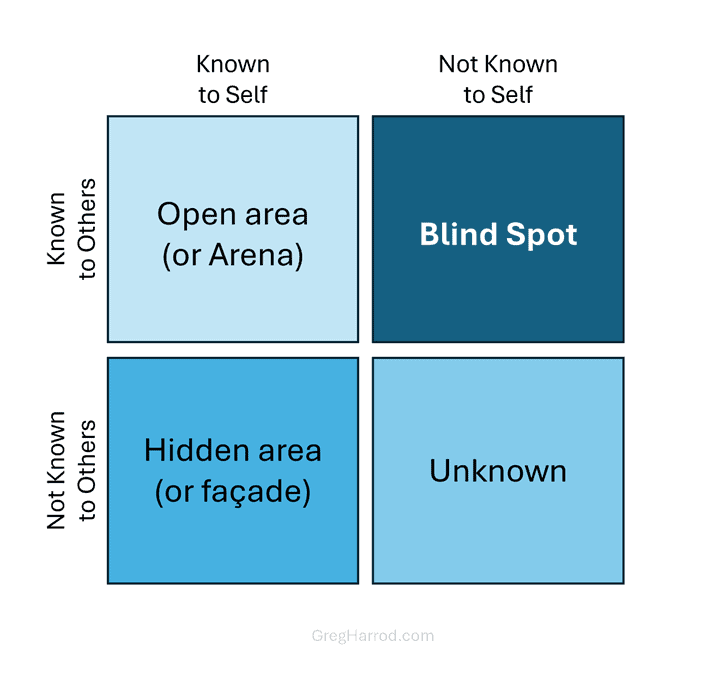
This diagram explains the concept.
There are things you know about yourself.
There are things others know about you.
And there are things others can see that you can’t.
That last category is the one that causes the most friction when you’re trying to get work done in your business.
A leader might think:
“I’m decisive.”
But the team experiences:
“He doesn’t listen.”
“She rushes decisions.”
It’s the same behavior but different people have different experiences and interpretations of the leader’s actions.
That gap is where friction starts.
Most of the time, leaders don’t see the friction clearly.
They just feel it.
Something’s off…
but they can’t explain why.
And, too often, their people don’t feel comfortable entering into a conversation about what they’re noticing and experiencing.
The behaviors that could be openly discussed and easily corrected go unmentioned.
Like George’s leftover bits of his lunch in his teeth.
Why Blind Spots Create Friction
People typically don’t struggle with your weaknesses.
They struggle with your lack of awareness of them.
If I say:
“I’m not great at follow-through. I’m working on it.”
People adjust. They help. They give grace.
But if I believe I’m excellent at execution while consistently dropping things, people don’t know how to respond.
It creates confusion.
And over time, that confusion turns into frustration.
Not because of what I can’t do.
But because of what I don’t see.
Why Self-Awareness Isn’t Enough
We hear this advice all the time.
“Be more self-aware.”
That sounds good, but it’s incomplete.
Because you can’t discover a blind spot by yourself.
If you could see it, it wouldn’t be a blind spot.
So the question becomes:
How do we actually see what we can’t see?
And maybe just as important…
how do we create an environment where people feel safe enough to tell us?
This is why so many leaders end up guessing.
They see the symptoms, but they don’t recognize the underlying pattern that’s causing them.
A Better Lens for Understanding Your Team
I use tools like the Six Types of Working Genius to help leaders see these patterns more clearly.
This gives you a way to see how work actually flows across your team.
We identify where ideas get stuck, where decisions slow down, and where execution breaks down.
Applying this model helps you and your team thrive, because it’s built around knowing the type of tasks you’re wired to do.
You’ll see what kinds of work give you energy and what drains you.
And you’ll discover something most leaders don’t see on their own.
It’s one of the most common blind spots leaders have:
Believing something is a strength when it’s actually a frustration.
This is where they’re forcing it.
We tend to confuse competence with fit.
Just because you can do something well doesn’t mean it’s where you do your best work.
And when you spend too much time in areas that drain you, it shows up.
It affects your tone, your level of patience, and how you interact with your team.
I’ve seen leaders say:
“I’m great at driving results.”
But the team experiences pressure and micromanagement.
Or:
“I’m highly collaborative.”
But the team experiences slow decisions and lack of clarity.
The issue isn’t effort.
It’s misalignment between how I see myself and how others experience me.
The Conversation That Changes Everything
Blind spots don’t shrink through reflection alone.
They shrink through open, vulnerable conversations.
The kind that sounds like:
“Can I share something I’ve noticed?”
“You may not see this, but here’s how it lands for us.”
“You say this energizes you, but we’re experiencing something different.”
Those are not always easy conversations.
But they are the ones that create real change.
Because they move something from unknown to you…
to known by both of you.
These conversations don’t just help you see yourself more clearly.
They help you stop guessing so you can see what’s actually happening with your team.
You’ll discover things like where work is getting stuck, where people are misaligned, and where you’re carrying more than you should.
And once something is out in the open, it can be addressed.
Why This Builds Trust
There’s a fear here for a lot of leaders.
If I admit I’m not good at something, will I lose credibility?
If I say I don’t really enjoy parts of my job and have to force myself to do certain things, will I be looked down on?
In my experience, the opposite happens.
When people know what you’re great at and where you struggle, they actually respect and trust you more.
They feel the freedom to talk more openly with you and to offer help more quickly when they see you need it.
But when they think you’re unaware, they go quiet.
And when people go quiet, problems don’t get solved.
They just stay hidden and they get worse.
A Simple Next Step
You don’t need a full Working Genius assessment to get started.
Just try this.
Ask yourself:
Where might I be overestimating my strengths?
Where might others experience me differently than I think?
Then ask someone you trust:
“What’s something you’ve noticed but I may not be seeing about myself?”
And when they answer,
Don’t defend.
Don’t explain.
Just listen.
Doing that can be more powerful than you might expect.
You’ll demonstrate that you sincerely want to see what you’re missing. You want to grow as a person and as a leader. You want to get better.
Your humility and vulnerability will establish a pattern for your team to follow.
And mutual trust and respect within your team will build, along with their performance and results.
What You Can’t See
I’ve found that most leaders don’t need more advice.
They need better visibility into how work is actually getting done (or not getting done) with their teams.
They need a way to see what’s really happening, so they can make better decisions about what to fix.
The goal isn’t perfect self-awareness. We’ll always have our blind spots.
What makes leaders and the teams they lead function at the highest levels is much simpler than that.
The key is to create a culture where people feel the freedom to share what they see and you don’t.
When you do that, be prepared.
You may have someone stop you mid-sentence to suggest you take a quick trip to the restroom mirror.
And you might want to take your toothbrush with you.
Helping you lead with clarity and confidence,
Greg
If you’d like to see any of my previous newsletter issues, you can find them here along with other articles. And, if you’re not getting my weekly newsletter and would like to, just enter your info here.

Greg Harrod
Greg Harrod is a Business Coach and Strategic Communications Partner. Follow GregHarrod.com to learn how you can build clear communication, aligned teams, and simple rhythms so your business runs smoothly. Greg will help you learn how to go from daily firefighting to calm, confident leadership by sharing his 30+ years of experience leading teams and businesses.
A quick note about affiliates
Some of the pages on my website contain affiliate links to products, apps, and services. If you click through and purchase, I may receive a commission on the sale and you pay no more. My policy is to only affiliate with products and services that I believe will provide value to you.