The Search for the Expert
What’s your approach when you’re trying to learn something new?
I tend to start looking for “the expert.”
The person who’s done it longer.
The person with more experience.
The person who knows what they’re doing.
So far, so good. I’m on the right path.
But then I start veering toward a trap.
I often limit my search to someone with a certain title, or degree, or number of followers.
Last week, I got a good reminder about who I can learn from… and a valuable leadership lesson.
The Unexpected Teacher
Kiersten and I were setting up our booth to sell our Beast to Blanket Fiber Arts Curriculum at the Kansas Homeschool Expo on Thursday.
A guy named Caleb came by and we began to chat. It was typical small talk… until it took a surprising turn.
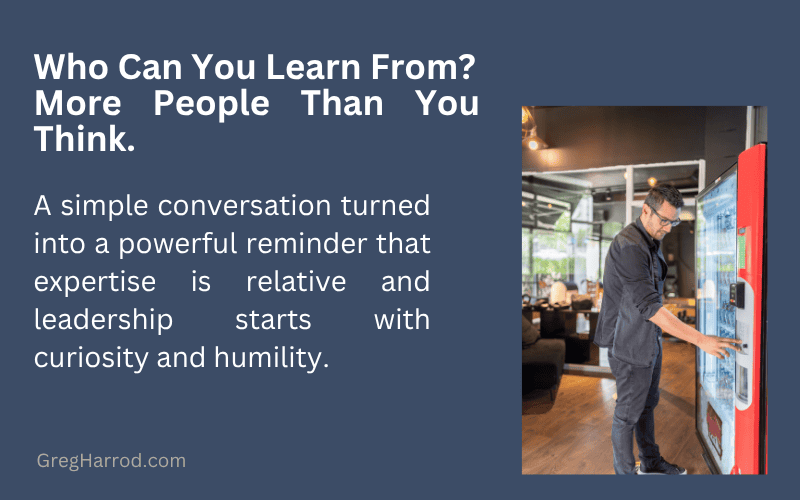
Before I knew it, I was getting a masterclass on how to run a vending machine business.
Here’s why it was so surprising.
Caleb is a 9th grader. A freshman in high school.
(Well, maybe he’s a 9th grader… he’s somewhere in that range… there’s more to that part of the story, but I’ll save that to the end.)
When we first started talking and Caleb mentioned his business, I started asking a few questions and I figured I’d get a surface-level answer.
Instead, I got a full walkthrough.
Caleb explained how he thinks about product selection.
What sells and what doesn’t.
How quickly different items move depending on the location and customer base.
Where he gets his inventory and how he will change suppliers as he scales.
He talked about his current and potential locations.
Caleb had a list of ideal sites he’s contacting.
And different incentive programs for property owners.
He explained how he gets used machines at the best price.
Where and when to purchase them and what to avoid.
And then he walked through the numbers.
Not in a polished, presentation-ready way.
And definitely not with a 97-slide PowerPoint deck.
He just told me what he’s doing.
Caleb spoke clearly, confidently, and from experience.
The Subtle Assumption
What struck me wasn’t just what Caleb knew.
It was how close I came to missing the opportunity to learn from him.
I had an expectation I didn’t even realize was influencing me about who counts as an “expert.”
It wasn’t conscious or intentional, but it was definitely there.
I suspect it was mostly because of his slight build and youthful appearance.
He wasn’t like some 9th graders I’ve met who look like they spend most of their day in the weight room and tower over me.
But Caleb impressed me with his business experience and his humble attitude.
He wasn’t pretending to be an expert, and he wasn’t trying to impress me.
He was just freely sharing what he had learned and was still learning.
He didn’t need any more than this to teach me.
He just knew more than I did.
That was enough.
Expertise Is Relative
We tend to forget that expertise is relative.
We think it’s something absolute.
You either have or you don’t.
We tell ourselves that being an expert is something that comes with years, titles, credentials, or a certain stage of life.
But most of the time, expertise is relative.
To a fourth grader, a fifth grader is an expert. (Credit to author and entrepreneur Ryan Levesque for that phrase.)
Not because the fifth grader has mastered everything.
But because they’ve already walked the path the fourth grader is about to step onto.
They remember what was confusing.
They know where people get stuck.
They can explain it in a way that actually makes sense.
One Step Ahead Is Enough
That’s how most real learning happens.
Not ten steps ahead.
One step ahead.
Someone who just figured out the thing you’re trying to figure out.
Someone who still remembers what it felt like to not know.
Someone who can explain it in a way that actually makes sense.
How This Shows Up in Leadership
This has real implications for how we lead.
Because we don’t just carry assumptions about who we learn from.
We carry assumptions about who we listen to.
Who we take seriously.
Who we give space to contribute.
If we’re not careful, we build invisible filters.
We listen more closely to people with:
More impressive titles.
More direct reports.
More experience.
And, if we’re not careful, we can unintentionally tune out people who don’t check those boxes.
Even when they’re closest to the work and have just solved the exact problem we’re facing.
We can miss the people with the clearest, most practical insight.
The Cost of Overlooking People
I’ve seen this play out on teams more times than I can count.
A leader asks for input.
The most senior voices speak first.
Quickly the conversation gets anchored around what they said.
And the person who has the best insight stays quiet.
Not because they don’t have something to say.
But because they’re not sure it’s their place.
This is especially common when a group is made up of people with different levels of formal education.
In a manufacturing environment, this can be a cross-functional team with factory workers with decades of hands-on experience from the shop floor working alongside design engineers with advanced degrees.
Or a business with a leader who has an MBA from a prestigious university and a majority of workers who “only went to trade school.”
Sometimes our definition of an “expert” causes the people with the most valuable input to keep it to themselves.
As a result, problems that could be solved quickly don’t get fixed.
And we wonder why things don’t improve.
On most teams, the issue isn’t intelligence or effort.
It’s failing to tap into and use the knowledge we already have.
We’re not accessing the right insight.
Because we’re looking in the wrong direction.
The Other Side of the Problem
At the same time, there’s another side to this.
And it’s just as limiting.
We often underestimate ourselves.
We tell ourselves we’re not ready.
We don’t have enough experience.
Or enough knowledge.
Or the right degree.
So, we hold back.
We wait until we feel like an expert before we speak up.
We don’t share what we DO know or offer to help.
As a result, others don’t benefit from our experience.
They make the mistakes we could help them avoid.
Our team members struggle down the path we’ve already walked.
What That 9th Grader Modeled
But think about that 9th grader for a second.
If he had waited until he felt like a true expert, I wouldn’t have learned anything from him.
What made the conversation valuable wasn’t that he had everything figured out.
It was that he was one step ahead of me in that specific area.
And he was willing to share what he knew.
That’s leadership.
Not in the formal sense.
But in the practical, everyday sense that actually moves things forward.
A Better Way to Think About It
Leadership is often simpler than we make it:
Be curious.
Ask questions.
Look to learn from anyone.
And be willing to share what you know with the person right behind you.
That requires a shift.
From asking,
“Who’s the expert here?”
To asking,
“Who knows something I don’t?”
From asking,
“Am I qualified to speak?”
To asking,
“Could this help someone?”
Those are very different questions.
And they lead to very different outcomes.
What This Means for Leaders
If you’re leading a team, this matters even more.
Because your assumptions become the team’s culture and their learned behavior.
If you only listen to the most experienced voices, your team will do the same.
If you create a safe space that welcomes and values insight from anyone and everyone, your team will start to bring it.
What This Means for You
And if you’re building something, learning something, or trying to improve something yourself…
This is freeing.
You don’t have to find the perfect expert to make progress.
You just have to find someone who’s a little further along than you are.
And you don’t have to wait until you feel like an expert to be useful.
You’re already ahead of someone.
In something.
So teach what you know. Whatever that is.
One Step Ahead
That 9th grader didn’t need 30 years of experience to teach me something valuable.
He just needed to be one step ahead.
And he was.
So here’s what I’m taking with me from that conversation.
Pay attention to who you might be overlooking.
And don’t underestimate the value of what you already know.
You don’t need to be the expert.
You just need to be willing.
Helping you lead with clarity and confidence,
Greg
PS – There’s more to the story about Caleb being a 9th grader… so here it is.
First, you need to have some background on me and my wife, Kiersten.
My three boys went to a public school. My first wife and I tried to homeschool for a bit, but it was just not a good fit. But many of our friends homeschooled their kids and I think it’s an outstanding education option to consider.
So, while I respect homeschooling parents, I am not one.
Kiersten, on the other hand, taught all four of her kids and countless other students through homeschool co-op programs.
You need that context to understand the conversation Kiersten and I had when I told her about my conversation with Caleb.
It went something like this:
Kiersten: “How do you know he’s in 9th grade?”
Me: “I asked him.”
Kiersten: “Greg Harrod, you did NOT just ask a homeschooled child what grade he was in.”
Me: “I did.”
Kiersten: “Greg, where are you right now? You are at a homeschool convention!”
I then received a brief, but highly effective, lesson from Kiersten on the challenges of identifying exactly where a student is on their learning journey when being educated at home.
She quickly helped me understand how difficult it is for a parent, let alone a teenage boy talking to a complete stranger, to explain this.
And suddenly I realized why Caleb could confidently walk me through all the ins and outs of his vending machine business.
But had a stunned, deer-in-the-headlights look on his face when I asked him what grade he was in.
Yet another learning experience for me…
It reminded me of this video by comedian and homeschooling dad, Tim Hawkins:
If you’d like to see any of my previous newsletter issues, you can find them here along with other articles. And, if you’re not getting my weekly newsletter and would like to, just enter your info here.

Greg Harrod
Greg Harrod is a Business Coach and Strategic Communications Partner. Follow GregHarrod.com to learn how you can build clear communication, aligned teams, and simple rhythms so your business runs smoothly. Greg will help you learn how to go from daily firefighting to calm, confident leadership by sharing his 30+ years of experience leading teams and businesses.
A quick note about affiliates
Some of the pages on my website contain affiliate links to products, apps, and services. If you click through and purchase, I may receive a commission on the sale and you pay no more. My policy is to only affiliate with products and services that I believe will provide value to you.