A leader in my Leadership Clarity Accelerator recently told me her team had done Working Genius a couple of years ago.
They learned their Working Geniuses and their Working Frustrations. They spent hours reviewing what the results meant. They got a presentation on the basics of the model.
Then, as she put it, the message was essentially, “Okay, good luck.”
You may know that feeling.
I know I’ve had similar experiences throughout my career.
You and your team are given a useful assessment or framework. People recognize themselves in the results. The conversation is interesting. Then everyone goes back to their jobs, and work looks pretty much the same.
Nothing really changes.
That’s happened to me more times than I can remember.
So what this leader in our LCA cohort said next has really stuck with me.
She explained to our group that talking through how Working Genius shows up in their day-to-day work had been more valuable to her than the hours spent learning the model. She told us it was finally “clicking now.”
That’s what an intentional, facilitated conversation can do.
An assessment gives people language. A team map helps them see patterns. But a facilitated conversation gives them room to ask things like,
What does this explain on our team?
Where is this happening in our business?
What could we try doing differently this week?
Discussing questions like these can bring about real change.
When a group of leaders is fully focused and engaged in a discussion, they spark thoughts for each other and they challenge one another.
They don’t feel rushed to get to a solution immediately or to have the exact right answer.
Good questions often lead to better questions.
And those questions lead to insightful discoveries and meaningful actions.
Bad meetings can become productive and effective.
Tasks can be strategically reassigned to new owners who are a better fit for the work.
Managers can provide better support for someone on their team whose work has become draining.
You can do this with Working Genius or any other framework your team uses. Here are three ways to help the learning stick:
1. Start with real work. Bring a current project, a recurring meeting, or a task that keeps landing on the same person. Ask the team what the framework helps them notice about it. An actual situation gives everyone something to work through together. And it allows the team to focus on the tasks, not the individuals, so people are less likely to get defensive.
2. Make room for different experiences. Ask each person where the work gives them energy and where it takes energy away. Listen without treating anyone’s answer as a problem to fix. People are more likely to speak honestly when they feel understood and respected.
3. Try one change, then talk about what happened. Adjust one responsibility, change who participates in one part of a project, or run one meeting differently. Come back to it the following week. What improved? What still feels difficult? What did you learn about each other?
The goal isn’t for everyone to become a technical expert on every minute detail about the framework or the model. It’s for the team to understand one another well enough to communicate more clearly and get better work done together.
Because the ultimate goal of using any framework or model is the same as for your business: to deliver results.
I’m going to add one more recommendation to these three tips.
Have someone outside of your team facilitate your discussions.
Of course, you can do this yourself or have someone on your team do it.
If you’re using the Working Genius model, you may even have a Certified Working Genius Facilitator on your team or you may be certified yourself.
So why shouldn’t one of you be the facilitator?
There are several reasons, but these are the ones I’ve seen cause the biggest problems.
- Someone on the team has a stake in the conversation. That doesn’t mean they can’t lead it well. But it can be hard to ask questions without bringing your own assumptions, frustrations, or preferred solutions into the discussion. An outside facilitator can notice patterns and ask questions that someone inside the team might miss.
- Facilitating is a job of its own. Someone needs to watch the time, invite quieter people into the conversation, and keep any one person from dominating it. If you’re doing all that, you can’t give your full attention to what you’re learning about your team.
- People respond differently when their leader holds the agenda. Even when you genuinely want honest input, team members may hesitate to challenge an idea or say something they think you won’t want to hear. When someone else facilitates, you can put down the agenda, listen, and participate in the discussion. That can make it easier for others to share their perspectives, too.
That may sound like a big sales pitch for you to hire me to do a Working Genius session with your team. So you can say not only that you’ve done Working Genius but that you’ve done something with it in your business.
And I suppose in some ways it is.
That’s what I do in the Leadership Clarity Accelerator sessions. And I’ll do the same thing for you and your team when you have me do a Leadership Team Clarity Intensive session.
But the facilitator doesn’t have to be me. It can be someone from a different department within your company. Or a person you know from another business.
You’ve got options for finding a facilitator to guide your conversations to produce the results you’re looking for.
Whether you’re using the Working Genius framework or something else, don’t let it simply be head knowledge.
Find a way to make it click with your team.
That takes more than looking at a report. It takes an intentional conversation with a facilitator who can make sure it sticks.
If you’d like me to help you in this way, reply and let me know. I’d consider it a privilege to serve you and your team.
Helping you lead with kindness and confidence,
Greg
P.S. The next Leadership Clarity Accelerator cohort begins October 8. It’s a small group where I facilitate conversations to help leaders like you stop doing work their team is ready to own. It’s all about reclaiming your time and developing your people (including you!). I’ve only got a few spots left at this point, so let me know this week if you’re interested.
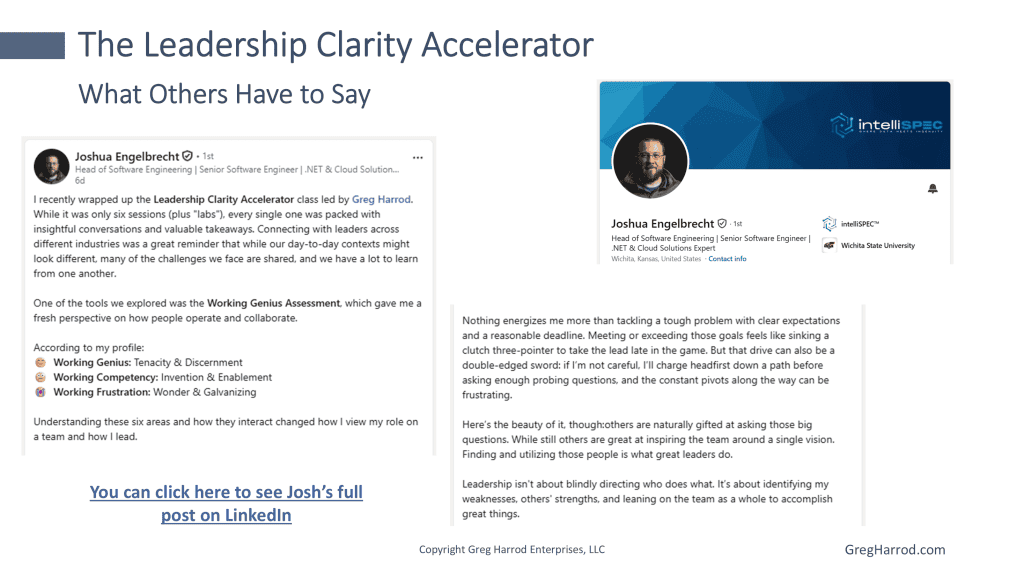
Here’s what Josh Engelbrecht shared on LinkedIn about his experience in LCA.
P.P.S. I had the privilege of being on The New Flat Rate podcast with Danielle Putnam and Natalie Koop and our conversation recently went live. If you’re in the HVAC industry, you likely know Danielle. If you don’t, connect with her on LinkedIn here and tell her I sent you.
You can watch our conversation on YouTube here.
The Leadership Blind Spot That Keeps Great Teams Stuck with Greg Harrod

If you prefer, you can listen to the whole episode here.
If you’d like to see any of my previous newsletter issues, you can find them here along with other articles. And, if you’re not getting my weekly newsletter and would like to, just enter your info here.

Greg Harrod
Greg Harrod is a Business Coach and Strategic Communications Partner. Follow GregHarrod.com to learn how you can build clear communication, aligned teams, and simple rhythms so your business runs smoothly. Greg will help you learn how to go from daily firefighting to calm, confident leadership by sharing his 30+ years of experience leading teams and businesses.
A quick note about affiliates
Some of the pages on my website contain affiliate links to products, apps, and services. If you click through and purchase, I may receive a commission on the sale and you pay no more. My policy is to only affiliate with products and services that I believe will provide value to you.