
I’m sure you know how this phrase ends.
“Don’t bring me problems…”
You’ve heard it more times than you can remember and may even say it to your own team members.
“Don’t bring me problems. Bring me solutions.”
This is a great message for your people to hear.
But there’s a subtle danger that can bite you if you lean into it too hard.
That’s what several highly experienced, thoughtful leaders and I realized as we dug into this during our live working session on Friday.
If you’ve joined us on one of these calls, you know that we always start with a specific topic and use real-life scenarios we’re dealing with in our businesses to guide our conversations.
We always go deep as we explore the nuances that we often miss when we’re thinking through a challenge by ourselves.
That’s what happened again Friday.
We started with the topic What Should I Stop Doing for My Team?
My friend and former co-worker, Scott Dunaway, agreed to be in the spotlight to share his experience in this area.
Before I go on, I encourage you to click here and connect with Scott on LinkedIn so you can get to know him and start learning from each other. He’s an outstanding leader, Certified Working Genius Facilitator, US Marine, and a humble guy who wants to keep improving.
That was evident as Scott explained what he had learned about himself recently. Here’s how he put it.
“As I transitioned out of individual contributor and back into being a supervisor, I’ve been working on not falling into the trap of being a ‘rescuer.’ I am the leader in this scenario that needs to stop doing work so that my people can grow!”
Applying our shared belief that “the best leaders are the most self-aware leaders,” Scott recognized the rough edges of his Working Geniuses (Discernment and Tenacity) and used that knowledge to lead his team in a way that helped them to do more work on their own without being overly dependent on him.
We looked at his Working Genius profile and a team map and that’s what led us to start discussing the phrase “Don’t bring me problems. Bring me solutions.”
For some people you lead, the challenge of that phrase will bring out the best in them.
Once you say it to them, they’ll never again come to you with a problem unless they have multiple solutions ready for you to consider.
They’re going to show you that they’ve thought through it and aren’t just expecting you to solve every struggle for them.
You’ve trained them to know that when they bring you a problem, you’re going to ask them something like, “What do you think we should do about it?”
So they’ve got a long list of ideas that they naturally came up with and they’re ready to impress you by demonstrating their natural ability to innovate (likely because they have the Working Genius of Invention).
That’s the positive side of having a reputation as a leader who doesn’t want to hear a problem unless it’s presented with possible solutions.
But do you see the downside?
Here are some perspectives from the leaders on Friday’s call to help you see what too many leaders miss.
What if you have a person on your team who’s gifted at spotting problems long before anyone else but they’re not so good at coming up with ideas by themselves?
This might mean they have the Working Genius Pairing of Wonder and Discernment and one of their Working Frustrations might be Invention.
They’re amazing at working with another person to evaluate and analyze potential solutions but they’re downright awful when it comes to quickly generating ideas to address the important problems they discover.
And, on top of that, they’re a slow processor so they need time to evaluate and consider solutions before they’re comfortable recommending them. Some might even consider them to be “wishy-washy.”
How do you maximize their contribution to the team?
Is it by expecting them to do what they’re not naturally wired to do?
Like quickly providing a viable solution to every problem they see.
How does only putting the spotlight on the other team members who bring problems and solutions impact them?
Does it bring out all they have to offer and allow them to recognize that they too contribute to the overall performance of the team and the business?
We all know you can’t fix a problem until you are aware of it. It’s a two-step process.
But too often we only reward and recognize team members who are built to do the second stage, fixing.
We tend to undervalue the skill of recognizing problems before they’re blatantly obvious.
Might this pattern unintentionally cause our team members who add the most value during this first stage to feel like they’re not all that important to the team?
Worse yet, could you unknowingly be replaying an all-too-familiar soundtrack in their mind that reminds them of the words they’ve heard all their lives?
“You’re too critical.”
“You’re such a downer.”
“You never have any good ideas to share.”
“You’re just trying to shoot holes in all our good ideas.”
“Why can’t you be like your big sister and come up with a solution?”
With this history, they feel like the way their mind works isn’t a blessing. It’s a curse.
When they’ve got that message echoing in their head all day and feel the additional pressure to not come to you with an issue unless they can give you a resolution, there’s no way they’re going to contribute to their fullest potential.
Thankfully, our small group of leaders recognized this danger we could have missed as leaders working independently.
And we shared our insights and perspectives.
We talked about the negative results that come when our team members hesitate to tell us about a problem immediately.
Early awareness of issues is something every leader wants and needs.
You want to know if there’s a threat to your business as early as possible. Even if no one has any ideas on how to mitigate that risk yet.
We had a lot of folks from manufacturing on the call Friday so our minds naturally went to the shop floor.
We shared examples in which we would never expect team members to stay quiet about a problem until they could bring a solution.
Do you want your employee to tell you about a safety issue immediately?
Do you want them to let their coworker’s life remain in danger until they can present a viable solution?
Do you want the person on the production line to keep building hundreds of units that will have to be reworked because of the quality problem they notice but don’t know how to fix?
Of course you don’t.
You know that there are situations in which the advice to not bring you a problem unless you have a solution doesn’t make sense.
And there are times when it does.
You know that.
The key is having enough self-awareness as a leader to recognize the power of the words, and being thoughtful and intentional with what you say so you’re not misunderstood and cause unintended negative consequences.
When you understand how you can help every person on your team contribute the most, even those who are wired differently than you are, you can adjust how you show up and communicate.
This makes you a better leader for the people under your care.
Just like Scott is doing.
When your self-awareness and your awareness of others grow, so does your effectiveness as a leader. Your people will develop and your business will grow.
Those of us who were on the call Friday experienced this personal growth as we challenged and encouraged each other.
These discussions all start with one topic to get our thoughts flowing.
I’m making plans for our next live working session and I’d like your help if you’re willing.
Which of these topics would you find most valuable?
- Why Isn’t Delegation Working on My Team?
- How Do I know Who’s Ready for More Responsibility?
- How Do I Hold People Accountable Without Micromanaging?
- How Can I Use Working Genius to Make My Team More Effective?
Or if you have an idea that’s not on the list, I’d love to hear it too.
If there’s a problem you’ve identified and are working through, you’re welcome to share it with me by replying to this email. I read every one.
And don’t feel any pressure to bring me a solution along with your problem.
Problem solving involves two steps.
And the first is just as valuable as the second.
Helping you lead with kindness and confidence,
Greg
P.S. I still have a few spots open for the Leadership Clarity Accelerator program that starts October 8.
It’s for leaders who:
- Work as a part of a team
- Have a formal or informal leadership role (with or without direct reports)
- Want to stop doing work their team is ready to own so they can reclaim their time
Would this help you or someone you know?
If you think it might, grab some time on my calendar so we can talk more about it.
https://gregharrod.com/schedule
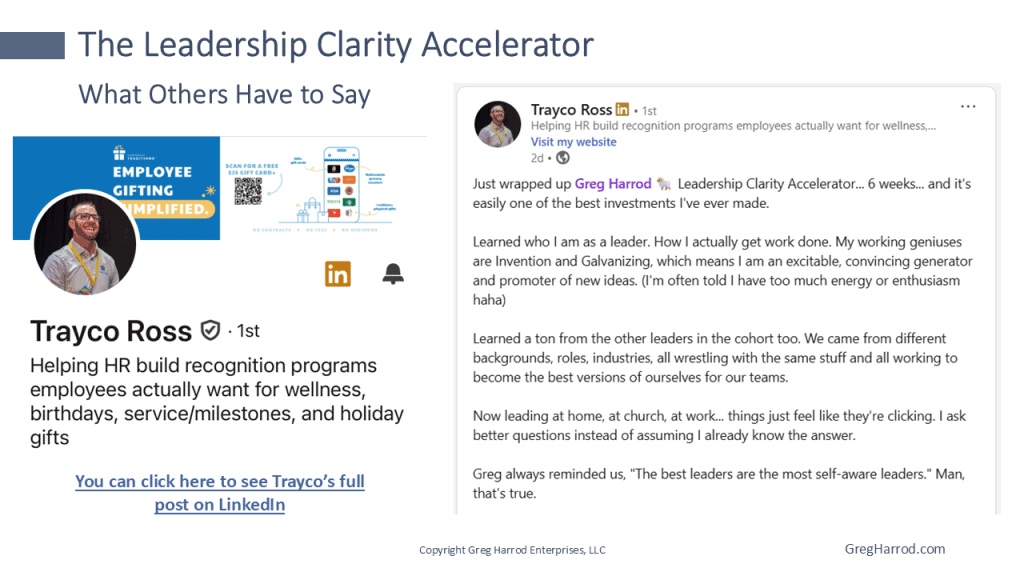
Here’s what Trayco Ross shared on LinkedIn about his experience in LCA.
If you’d like to see any of my previous newsletter issues, you can find them here along with other articles. And, if you’re not getting my weekly newsletter and would like to, just enter your info here.

Greg Harrod
Greg Harrod is a Business Coach and Strategic Communications Partner. Follow GregHarrod.com to learn how you can build clear communication, aligned teams, and simple rhythms so your business runs smoothly. Greg will help you learn how to go from daily firefighting to calm, confident leadership by sharing his 30+ years of experience leading teams and businesses.
A quick note about affiliates
Some of the pages on my website contain affiliate links to products, apps, and services. If you click through and purchase, I may receive a commission on the sale and you pay no more. My policy is to only affiliate with products and services that I believe will provide value to you.