Ariel, a first-time supervisor, has big problems with her team dynamics and she doesn’t even know it.
She can’t see what’s really going on with Monica and the rest of the people on her team, and it’s costing her time, money, and trust.
Favoritism, as Monica said she was experiencing, will do that.
That’s where we ended last week’s issue. You can catch the full story here if you missed it.
Now let’s go back to Ariel and her team.
One of These Things is Not Like the Others
Ariel’s a task-oriented leader who loves to drive things across the finish line. And she’s hired people who are wired like she is.
Ganesh, Leo, and Jim all get energy from seeing work get completed. They love to check things off their “to do” list.
Just like Ariel.
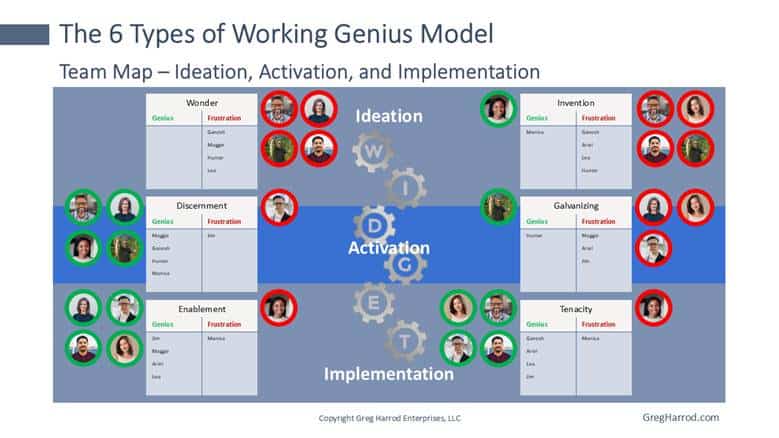
Naturally, the Working Genius map for Ariel’s team showed a cluster of people with the Working Genius of Tenacity.
But Monica was not in that group.
She doesn’t enjoy doing all the detailed tasks a project requires. And, frankly, she isn’t very good at it.
Tenacity is Monica’s Working Frustration not her Working Genius.
Take a look at the Working Genius map for Ariel’s team.
The red circles highlight areas of frustration while the green circles identify work that naturally energizes each person.
Monica reports to Ariel.
But she didn’t hire her.
Ariel “inherited” Monica when she stepped into her new role as the supervisor of the group.
And here’s what was happening.
Judgment and Eroding Self-Confidence
Instead of Ariel, and the rest of the team, recognizing that Monica adds value in different ways, they began to judge her.
It was obvious to everyone, including Monica, that she didn’t enjoy doing all the detailed work that’s required to complete a job. She did those things, but not as well as they did. And with much less enthusiasm.
So, Monica’s teammates began to think less of her.
And, sadly, Monica began to think less of herself.
She felt increasingly guilty about not performing at the same level as her coworkers when it came time to finish projects.
Monica was beginning to lose her confidence.
She didn’t say anything to Ariel about how she was feeling.
Her teammates didn’t share any of their thoughts about Monica with anyone either.
But they were there.
And what was slowly building below the surface started to come out as subtle, but very real, favoritism.
Unintended Favoritism
Monica stopped being included in important project discussions.
She would find out later that she hadn’t been invited to meetings she used to attend.
Monica didn’t mind missing those meetings. In fact, she hated listening to all the details about the specific action items and critical deadlines.
What bothered her was that no one told her why she was being left out.
So, she started to question whether she should stay with the company.
She began spending more time on LinkedIn.
That’s where she saw the Leadership Clarity Scorecard link on my profile and took the assessment.
Seeing What’s Really Going On
The Leadership Clarity Scorecard is another tool I offer to help leaders better understand and articulate what’s causing misalignment and friction for themselves and their teams.
Monica’s results told a predictable story.
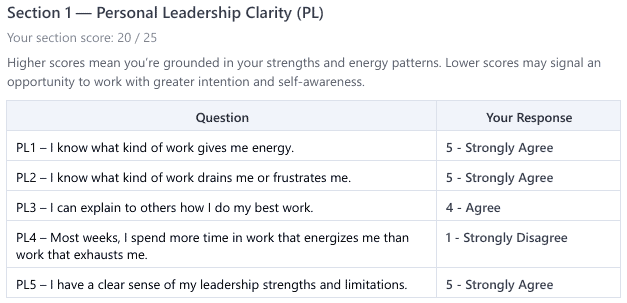
Check out her response to this question:
“Most weeks, I spend more time in work that energizes me than work that exhausts me.”
She picked the most negative response: “Strongly Disagree”.
No wonder Monica was looking for a new job!
She was burning out.
Monica also felt like an outsider on Ariel’s team.
She felt pressure to be like Ariel.
And Ganesh.
And Leo.
And Jim.
But not like herself.
Monica didn’t feel the freedom to do the work she was built to do.
If you look closely at her answers to the other questions in the Personal Leadership Clarity section of the scorecard, you’ll see she has strong self-awareness. She knows what she’s designed to do. And she knows what drains her.
Monica’s problem wasn’t awareness.
The problem was that her environment didn’t allow her to work from her strengths.
So where was the disconnect?
Communication Gaps Make Leadership Heavy
Ariel didn’t know what Monica knew about herself.
And she didn’t know what kinds of tasks brought the other members of her team joy, energy, and fulfillment either.
That’s a big problem when you lead a team.
Ariel and the people on her team were working hard and they were delivering good results. But something still felt off.
They had areas of friction they couldn’t quite identify.
Their decision-making process was slower than it should have been.
And too much still depended on Ariel to push work forward.
They weren’t having open conversations as a team about who should be doing what to make the team most effective.
As a result, Ariel was feeling the weight of carrying work that her team should have been owning.
This is especially painful to think about because it was preventable.
Ariel created an environment that was slowly crushing her.
She did this unintentionally by continuing to do what she had always done as an individual contributor. And hiring people like herself.
A Common Error with Costly Consequences
This is common for new leaders and perfectly understandable. Ariel continued to do what made her successful and got her promoted.
But she didn’t see the problems she was creating.
She wasn’t aware that, if she’s not careful, she’s going to lose Monica.
That unintended favoritism Monica is feeling from Ariel is the reason she’s picking up the phone when the recruiters call.
And Ariel’s problem is even bigger than that.
Monica’s not the only one feeling this way.
Hunter is updating his resume too.
As the only member of the team with the Working Genius of Galvanizing, he’s also feeling underutilized and undervalued.
Ariel isn’t aware that her forced efforts to rally the team and get them moving in the right direction are falling flat.
She’s trying to hide her frustration when she’s doing this type of work, but it’s obvious she doesn’t want to be the group cheerleader.
Hunter, on the other hand, would love to be given the chance to fill that role. That’s what he’s built to do. And he’s really good at it.
But Ariel doesn’t know that about Hunter. Just like she doesn’t know how Monica is uniquely gifted.
That’s how small blind spots turn into expensive leadership problems.
If Ariel hadn’t seen what was actually happening with her team and acted on what she learned with these tools, this is what she would have been facing in just a few months.
She was going to get not one, but two resignation letters.
Monica and Hunter would have left and Ariel would have had two open spots to fill on her team.
And, as her recruiting costs were skyrocketing, she was going to once again be searching for candidates who are just like her instead of designing her job postings to match the gaps she has on her team but still couldn’t see.
I’ve seen it happen and can tell you it’s real. And it’s a shame because it doesn’t have to be that way.
Ariel had options.
If her situation hits a little too close to home for you, I invite you to consider them as well.
What You Can Do to Avoid the Negative Impacts of Favoritism
To prevent losing Monica and Hunter, Ariel could take her team through a Leadership Team Clarity Intensive workshop.
This interactive event eliminates miscommunication, reduces friction, and helps teams work together in a healthier, more aligned way.
If that doesn’t fit her budget, she could apply the Working Genius model on her own.
Or, at least start with a simple conversation with each of her team members to ask them what type of work they enjoy and what type of tasks drain them.
If she’s feeling brave, she could even invite them to share if they’re sensing any favoritism within the group. Or if they ever feel like outsiders.
Even small, courageous steps like this can bring out meaningful improvements in team cohesiveness and alignment.
Because when leaders and teams become aware of what’s really going on, they can turn diversity that was causing disconnect and isolation into an asset.
Awareness Brings Increased Productivity
Knowing and applying how each team member is built to do work will allow Ariel’s team to function more productively in all three phases of projects.
They’ll be strong from start to finish, not just in the final steps of implementation where Ariel and those who are wired like her do their best work.
Through an open conversation centered on discussing the team’s Working Genius team map, attitudes change. And unintentional favoritism goes away.
The discussion isn’t about who’s doing work the right or wrong way.
It’s focused on how work gets done and who is built to do certain types of tasks.
As a result, that conversation doesn’t feel like a personal attack to anyone.
Those who aren’t wired the same way as the boss are seen as just as valuable as those who are.
In fact, team members like Monica who had been looked down on by others are often seen as even more important because they fill gaps the others can’t.
But without the insight gained by the personal Working Genius assessments and the team map, leaders don’t see what’s going on.
Like Ariel, they remain unaware.
So they lose talented people who could make their team even better if only given the chance.
What’s Next for You?
I’m curious about the thoughts you’re having as you consider this story of Ariel, Monica, and the rest of the team.
Who do you relate to the most?
Are you, like Monica, experiencing what seems like favoritism and feeling like an outsider on your team?
Or do you find yourself wondering if you’re in Ariel’s situation, with your team members looking for other opportunities and you don’t even know it?
Either way, here’s the good news.
Even by thinking about it, you’re becoming more aware of your team dynamics.
And you still have time to make corrections if you need to.
If you’re not sure what the best next step is for you, I’d be happy to talk through it with you.
Use this link to schedule a Complimentary Clarity Coaching Session with me then take the Leadership Clarity Scorecard assessment.
The session is a free 45-minute call to help you talk through the challenges you’re facing, review your Scorecard results, and get clarity about your next leadership step.
Helping you lead with clarity and confidence,
Greg
If you’d like to see any of my previous newsletter issues, you can find them here along with other articles. And, if you’re not getting my weekly newsletter and would like to, just enter your info here.

Greg Harrod
Greg Harrod is a Business Coach and Strategic Communications Partner. Follow GregHarrod.com to learn how you can build clear communication, aligned teams, and simple rhythms so your business runs smoothly. Greg will help you learn how to go from daily firefighting to calm, confident leadership by sharing his 30+ years of experience leading teams and businesses.
A quick note about affiliates
Some of the pages on my website contain affiliate links to products, apps, and services. If you click through and purchase, I may receive a commission on the sale and you pay no more. My policy is to only affiliate with products and services that I believe will provide value to you.