My first full-time job when I graduated in 1993 from Kansas State University was cool. Really cool.
I worked as an engineer in the Caterpillar Systems and Controls Research group where high-tech stuff was happening. We had GPS control systems moving dozer blades automatically and huge off-highway haul trucks with no drivers in rock quarries.
What’s common now was cutting-edge technology back then, and the sales team was just getting introduced to all these things. So even the application engineers didn’t have much grasp of how all this magic was done.
Except for one guy I’ll call Dennis.
Dennis would help us work with the customers to plan our testing. And he would ask us a lot of questions about how things worked.
When Dennis asked a question, one of the geniuses in the group would answer with way more detail than a non-PhD could possibly comprehend.
Without fail, Dennis would nod his head and give the exact same response every time. It was a reflex that he probably thought was harmless, but it damaged his reputation within the group.
We didn’t trust him.
I’ll come back to his response that will make you shake your head, but first let me show you how you do the opposite of what Dennis did.
Here are three ways you can build trust quickly in your business.
3 Ways to Build Trust Quickly in Your Business
There are many ways to build trust in the organization you lead. Deep relationships and the trust that goes with them take time to establish.
These 3 techniques will give you a head start down that path.
1. Be Trustworthy
This first point may seem like it could go without saying. But, sadly, based on what I’ve seen and experienced, it needs to be talked about.
If you want people to trust you and to trust each other, you need to be trustworthy.
How you behave is a direct reflection on your character. What you do shows people who you are and what you believe.
And it does more than that.
Your choices and actions set a pattern others will follow even if they don’t realize they’re mimicking you.
That’s how it works when you’re a leader.
So, to build trust in your business, make sure you’ve got the basics covered.
These are the things we’ve been taught since we were kids.
- Tell the truth, even when it’s uncomfortable.
- When you tell someone you’re going to do something, do it.
- Don’t share private information another person has trusted you with.
Your mom and dad likely told you the same thing mine told me. In fact, my mom still tells her great grandkids the same lesson she told my boys:
“Don’t lie. Because once you’ve broken trust with a person, it takes a long time to rebuild it.”
My mom’s right and so is yours. This childhood lesson we needed to apply in elementary school is even more important when we’re leading other adults in a business.
That’s the trust foundation to build on with this next step.
2. Admit You’re Human
I found this LinkedIn post by Jonathan Raymond encouraging. He’s the author of the book Good Authority: How to Become the Leader Your Team Is Waiting For, which I highly recommend.
Here’s the full post for context, but I want to point out what stuck out to me.
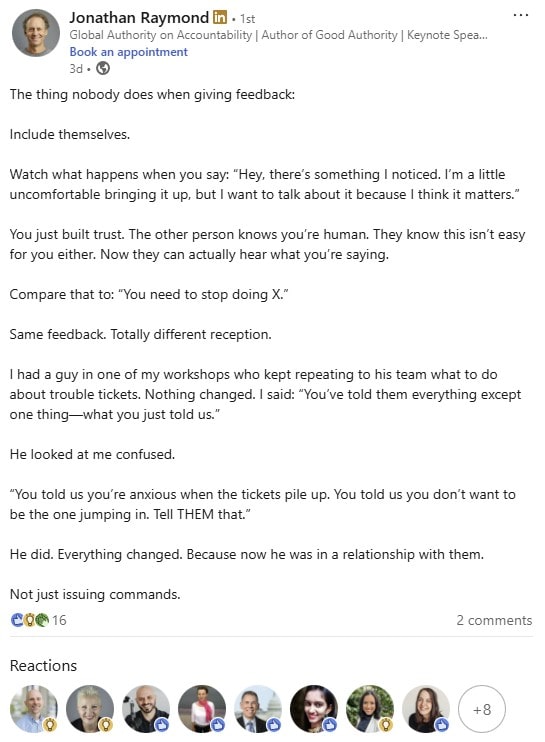
You can build trust and relationship with your team by doing something as simple as including this phrase in a sentence:
“I’m a little uncomfortable.”
As Jonathan points out, you’re telling your people something they already know. You’re human.
So, you have the same limitations and frailties they have.
When you verbalize this, you’re being vulnerable and authentic.
This act of humility builds trust.
Jonathan’s post reminded me of a universal truth and a valuable part of the Six Types of Working Genius framework many leaders aren’t aware of.
3. Own Your Rough Edges
The universal truth I’m referring to is that we all have “rough edges.”
The way we’re made and the things we do as a result can be irritating. We all naturally do things that annoy and frustrate other people.
We can’t help it. It’s just a part of being a unique individual interacting with other individuals who aren’t exactly like us.
Having a diverse team, while highly beneficial, necessarily introduces friction.
Personality assessments can be useful.
They help us understand who we are but not how we are designed to do work.
For that reason, I prefer to start with a productivity tool called the Six Types of Working Genius assessment before doing any personality tests with my clients.
When we complete our personal Working Genius assessment, we get an increased level of self-awareness.
And with that deeper insight into what types of work we are gifted to do and enjoy, we can build trust.
More specifically, when we know the rough edges that are common for our Working Genius pairing, we can be more vulnerable with the people we work with. We can talk openly about how we might frustrate and annoy those who work with us.
We have the language to describe why we simply aren’t good at some types of work so we can share that with our teammates without feeling guilty about it. And they can do the same.
Here are three examples of Working Genius pairings and the rough edges that go along with each of them.
The Contemplative Counselor (Working Genius pairing: Wonder and Discernment)
“A thoughtful, insightful, and nuanced advisor. Slow to declare certainty but deep in wisdom, intuition, and rationale.”
When you’re working with someone with this Working Genius pairing, they may frustrate you because of these tendencies.
- They often overthink and overanalyze decisions.
- Certainty seems more important than clarity to them.
- They can be too nuanced, and their questions often slow down meetings.
The Enthusiastic Encourager (Working Genius pairing: Galvanizing and Enablement)
“A warm and positive affirmer of others. Quick to support and inspire people who need energy or reassurance.”
While this person’s rough edges may not be obvious at first because they make you feel so supported and encouraged, these things will become evident over time:
- They get caught up in their own excitement.
- They may push you to do ideas that really aren’t very good.
- They seem insincere with their constant over-the-top enthusiasm.
The Judicious Accomplisher (Working Genius pairing: Discernment and Tenacity)
“A reliable, prudent, and focused doer. A unique combination of practical urgency and intuitive judgment.”
If this describes you, your rough edges may include:
- It doesn’t come naturally to wait for others to get started.
- You can be judgmental when others aren’t meeting your standards.
- You have an impatience that you prefer to refer to as a “strong bias for action.”
Imagine working in a company that’s implemented the Working Genius framework and being able to confidently tell someone:
“I think my Wonder and Discernment are starting to slow us down. I want to ask more questions, but I think it’s best if we go ahead and make a decision now.”
Or
“Jason, I appreciate the enthusiasm and encouragement that’s coming from your Galvanizing and Enablement. Thank you. I want to pause and think for a moment before I take the next step though.”
Or
“I apologize for being impatient with your team, Sarah. As you know, I have this tendency. What’s the earliest date for them to get this project done?”
When we are equipped with the shared knowledge of how each person on our team is made and the positives and negatives they bring with them as a result, we’re acknowledging reality.
This equips us to have clear, direct conversations with each other without feeling guilty or judged.
As leaders, we can approach ourselves and others with a posture of humility based on the knowledge gained from the Working Genius assessments.
Our willingness to share our own rough edges and talk graciously with others about theirs creates an environment of psychological safety.
When they see how we take these steps to intentionally build trust, those around us will also be more willing to talk openly about how what they do can negatively impact their coworkers too.
And they too can do this without feeling guilty about it.
Building Trust Isn’t Easy at First
Based on my experience, taking these three steps isn’t easy at first.
With practice, however, being vulnerable to build trust gets easier.
And as I said at the start, these are just the first steps of a journey to build deep, lasting trust in your business.
I also told you about Dennis, the sales engineer I worked with when I was with the Caterpillar Systems and Controls Research Group. The guy with lots of questions and his standard trust-destroying reply.
Why did the Caterpillar engineers not trust Dennis?
Back to Dennis
Here’s what Dennis would say after every Einstein-level explanation of the technology that went on to revolutionize the earthmoving world.
“That’s pretty much what I was thinking.”
As the new guy in the group with only a Bachelor’s Degree in Electrical Engineering, I was skeptical the first time I heard him say this.
“Really, that’s what you were thinking? Because I’ve been working directly with these geniuses for quite a while now, and I only understood about 5% of what Adam just said.”
When I witnessed this exchange multiple times, I realized Dennis had absolutely no clue.
He was a good guy, but his pat response wasn’t one of vulnerability and humility.
Intentionally or unintentionally, he was trying to cover up his shortcomings.
And it eroded trust instead of building it.
So, I encourage you to avoid being like Dennis and try these three techniques instead. I’m confident your team will recognize your efforts as genuine and heartfelt.
And when you share the realities of your humanity that they’re already aware of, they may even borrow Dennis’s line and deliver it with more sincerity than he did.
“That’s pretty much what I was thinking.”
Helping you lead with clarity and confidence,
Greg
P.S. I recently had a business leader tell me at the end of a Complimentary Clarity Coaching Session™ that he found it helpful because it provided him with “a safe place to process thoughts and bounce ideas.” He didn’t feel comfortable talking with anyone inside his organization, so he gave me the privilege of being his coach for about 45 minutes. If you would find that valuable too, let me know by booking a time here or sending me a reply so we can set up a time to talk.
If you’d like to see any of my previous newsletter issues, you can find them here along with other articles. And, if you’re not getting my weekly newsletter and would like to, just enter your info here.

Greg Harrod
Greg Harrod is a Business Coach and Strategic Communications Partner. Follow GregHarrod.com to learn how you can build clear communication, aligned teams, and simple rhythms so your business runs smoothly. Greg will help you learn how to go from daily firefighting to calm, confident leadership by sharing his 30+ years of experience leading teams and businesses.
A quick note about affiliates
Some of the pages on my website contain affiliate links to products, apps, and services. If you click through and purchase, I may receive a commission on the sale and you pay no more. My policy is to only affiliate with products and services that I believe will provide value to you.