This article is part of a series highlighting individuals who have benefitted from taking and applying the Six Types of Working Genius assessment. You can find more Working Genius Spotlights here.
The 6 Types of Working Genius Framework – The Basics
If the 6 Types of Working Genius Framework developed by Patrick Lencioni is new to you, here are a few key highlights to help you understand the model.
- The tasks we do to complete any project can be grouped into six different types or “geniuses”.
- Each of the six is required to accomplish any type of endeavor. Every “project” requires all six geniuses.
- No one person has all six Working Geniuses.
- Each type of genius receives and/or gives something to the adjacent type. There’s a natural flow of work: W-I-D-G-E-T.
The Six Types of Work Tasks or “Geniuses”
- Wonder: identifies the need for improvement or change
- Invention: confirms the importance of that need, and generates an idea or solution
- Discernment: assesses the merit and workability of the ideas or solution
- Galvanizing: generates enthusiasm and action around the idea or solution
- Enablement: initiates support and assists in the implementation of the idea or solution
- Tenacity: commits to ensuring that the idea or solution gets completed and that desired results are achieved
Greg’s Six Types of Working Genius Assessment Results
Working Geniuses
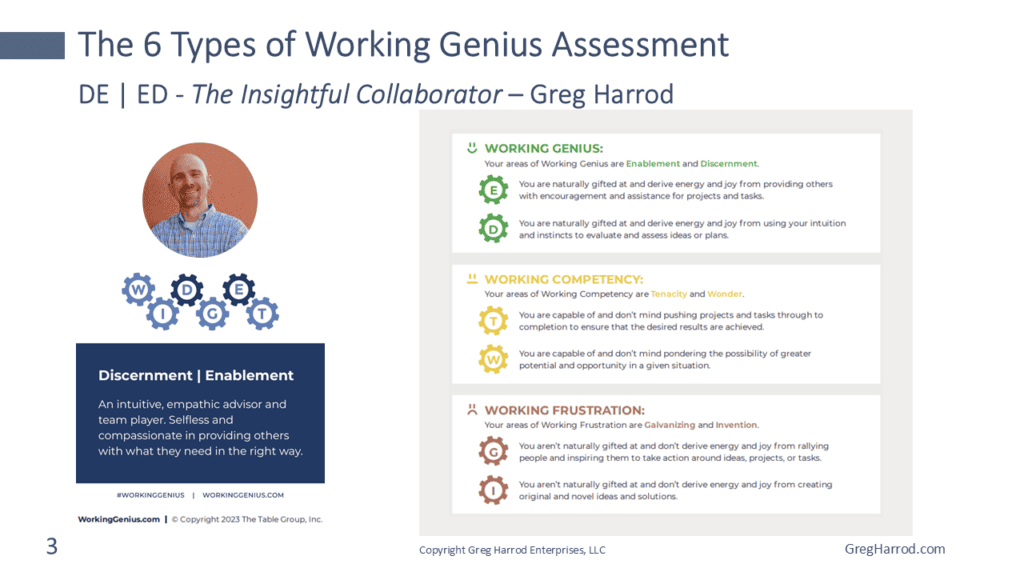
Our Working Geniuses are two areas that are considered our true geniuses or gifts. These are the activities that give us joy, energy, and passion. We are created to do these types of tasks!
Greg’s Working Geniuses are: Enablement and Discernment
Working Competencies
Our Working Competencies are those activities that neither feed nor drain us. We can do these fairly well for a limited period of time. But spending too much time working in these areas can eventually lead to exasperation and burnout.
Greg’s Working Competencies are: Tenacity and Wonder
Working Frustrations
Our Working Frustrations are types of activities that rob us of joy and energy. Most of us aren’t very skilled in these areas. Even if you’ve learned to excel in these types of tasks, your energy will be drained quickly when you’re working in your areas of frustration.
Greg’s Working Frustrations are: Galvanizing and Invention
Greg Harrod’s Custom Six Types of Working Genius Assessment Report
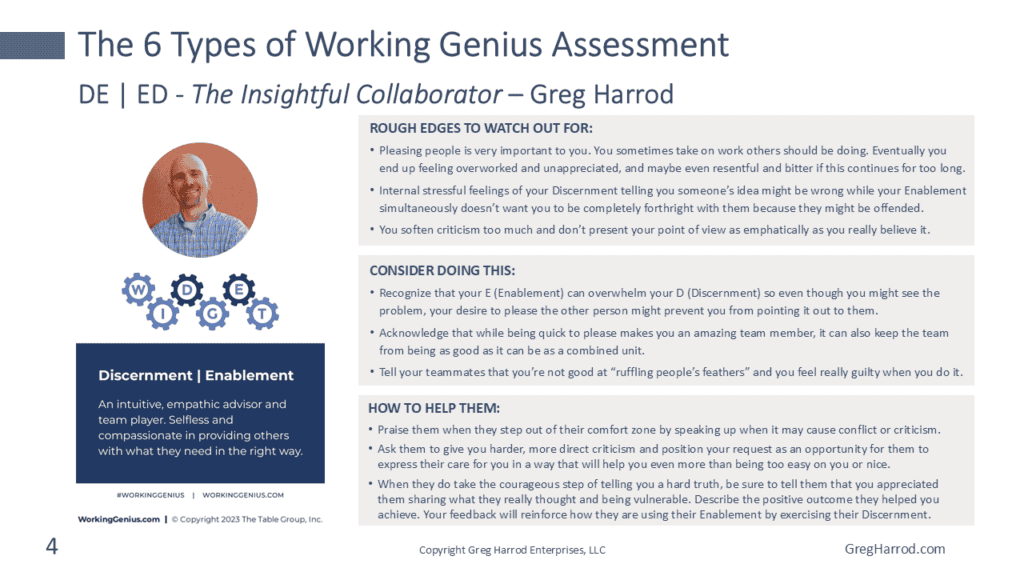
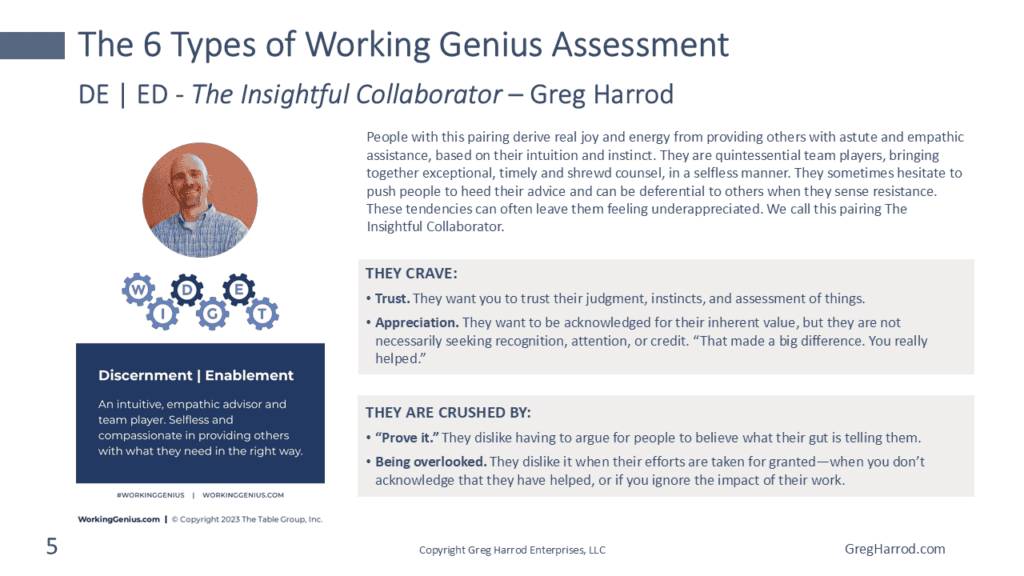
Here’s Greg’s custom, extended 6 Types of Working Genius Assessment report built from the basic report.
Greg’s Perspective
How Has The Working Genius Model Helped You Be a Better Leader?
Throughout my career, I’ve often had a nagging self-doubt that constantly chipped away at my self-confidence. These feelings were driven by the idea that I should be more of a cheerleader, the kind of leader who is up in front inspiring teams to do work even when they really didn’t want to. I somehow thought I needed to be more disruptive and aggressive to be a “real leader”.
I learned to act this way and rally the troops when I needed to as a leader, but I didn’t enjoy it. Doing these tasks drained the energy right out of me, even if I was successful doing it.
Thankfully, the Working Genius model helped me to understand that not all leaders are created to be Galvanizers. And, I didn’t have to feel guilty about not liking this type of work.
As you can see in my Working Genius Assessment Report, Galvanizing is one of my Working Frustrations. No wonder I didn’t feel fulfillment when being the cheerleader!
This realization allowed me to let others who DID have the Working Genius of Galvanizing do this work without feeling guilty or “less than”.
Similarly, I was able to recognize that my biggest contribution as a leader came in a more responsive approach because my Working Geniuses are Enablement and Discernment. Both of these function in response to input from other team members.
I don’t like to come up with completely new ideas from scratch (Invention), but I love to help others think through their ideas and serve as a sounding board for them (Discernment and Enablement).
While some, including me when I’m doubting myself, may not see this type of work as the skills of a “real leader”, they are.
The Six Types of Working Geniuses framework constantly reminds me of that and helps me be a more confident leader by showing me how I’m created to do work DOES add value to teams and businesses.
I can be an effective, successful leader not in spite of how I’m made, but because of it!
How Has The Working Genius Model Helped You Be a Better Team Member?
The increased self-confidence I described above makes me a better team member as well as a better leader.
Because of the Working Genius model, I now recognize how I can help others be more successful by using my Enablement and Discernment to support them.
I’m also able to communicate clearly with others, including my supervisors and clients, that while I am good at pushing tasks and projects through to completion (Tenacity) and have spent much of my career doing project management type work that requires this, it’s not what brings me the most fulfillment.
Because Tenacity is a Working Competency for me, I can do this type of work for a while and do it well. But, over time I’m going to get burnt out if this is all I’m doing.
So, I’m now more open and transparent to share that insight when I’m building a team so we can ensure that others with the Working Genius of Tenacity are doing the work that will eventually drain me but will energize them because they loved to do it!
I also found this snippet that describes my Working Genius pairing as “The Insightful Collaborator” helpful and encouraging as I do my work as a Business Coach.
“An intuitive, empathetic advisor and team player. Selfless and compassionate in providing others with what they need in the right way.”
This summary description reminds me of what I’ve experienced throughout my career.
I add the most value to teams and businesses (and I get the most personal fulfillment) when I’m supporting other people and helping them to be successful.
What Have You Found Most Helpful From Your Working Genius Assessment Report?
The Working Genius Assessment Report is helpful to me not only in the content it provides about each of my Working Geniuses, Competencies, and Frustrations but in the layout it uses.
I like the way the report shows my two Working Geniuses at the top (Enablement and Discernment) and my two Working Frustrations at the bottom (Galvanizing and Invention) separated by my two Working Competencies.
This ordering reminds me of where I should strive to invest my time and energy.
- Enablement: initiates support and assists in the implementation of the idea or solution (Working Genius 1)
- Discernment: assesses the merit and workability of the ideas or solution (Working Genius 2)
- Tenacity: commits to ensuring that the idea or solution gets completed and that desired results are achieved (Working Competency 1)
- Wonder: identifies the need for improvement or change (Working Competency 2)
- Galvanizing: generates enthusiasm and action around the idea or solution (Working Frustration 1)
- Invention: confirms the importance of that need, and generates an idea or solution (Working Frustration 2)
I should be spending the most time at the top of my list and the least time at the bottom.
There are a couple of things about this to remember.
First, my order of types of work is applicable to me, but not necessarily everyone else on my team. They should invest their time according to their list not mine.
Remembering this will help us have the strongest team.
Second, I will still have to do tasks that fall near the bottom of my list. In other words, we all have to do work that doesn’t energize us at times.
But knowing this helps me feel less frustrated and defeated when doing things that require Galvanizing and Invention.
Because I know these are my Working Frustrations, I don’t expect them to energize me. I can go into the work with a better mindset.
It’s amazing how much better I feel when I don’t expect to enjoy a task that is naturally unpleasant to me.
Learn More About and Connect with Greg Harrod
You can learn more about Greg Harrod on his website and connect with him through his weekly email newsletter or on LinkedIn.
Interested in Being Featured in a Working Genius Spotlight?
If you would like to share your Six Types of Working Genius Assessment and story in a Working Genius Spotlight article like this, please let us know using this form.
If you are already working with me through a paid coaching package, the Working Genius Spotlight is included and we can incorporate it naturally into our work.
I also like to help others build their professional communities and networks by sharing their Working Genius Spotlights in my weekly newsletter where I share short, practical insights to help leaders improve their team’s communication, alignment, and clarity without adding more to your plate. If you’re not already getting these emails and would like to, just enter your info here.

Greg Harrod
Greg Harrod is a Business Coach and Strategic Communications Partner. Follow GregHarrod.com to learn how you can build clear communication, aligned teams, and simple rhythms so your business runs smoothly. Greg will help you learn how to go from daily firefighting to calm, confident leadership by sharing his 30+ years of experience leading teams and businesses.
A quick note about affiliates
Some of the pages on my website contain affiliate links to products, apps, and services. If you click through and purchase, I may receive a commission on the sale and you pay no more. My policy is to only affiliate with products and services that I believe will provide value to you.