A couple of weeks ago a few of the leaders in my Leadership Clarity Accelerator cohort and I were talking about how we grew up.
Their perspectives were fascinating to me and I think you’ll find what they had to say interesting too.
We discovered that the very thing that helped us build our successful careers could very well be holding us back as leaders.
I suspect you’re going to want to put some thought into this too.
Here’s how the conversation went.
It started with a statement that went something like this:
“I’m used to being a doer. But as I advance in my career, I realize I need to do less and lead more.”
Pause and think about that statement for a minute because there are a lot of different ways to look at it and I don’t want you to be overly influenced by our views.
Here are a few questions to prompt your thinking:
- Does that sound like something you would say?
- Have you built your business and your career by doing?
- Do you feel like your current position requires you to lead more than do?
If you answered yes to any of those questions, you would have fit right in.
You know how to work hard because that’s how you were raised.
And your hard work got you to where you are today.
That was the case for every one of us in our small group.
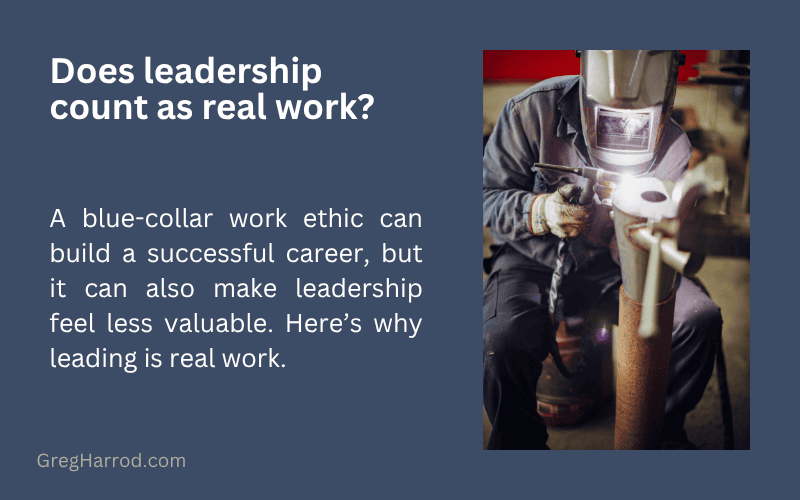
All of us also grew up in blue-collar homes.
My folks owned a blacksmith and welding shop that they bought in 1970, the year I was born. My brother still runs our family business, which is now focused on oil field work.
It’s going to be 104 F degrees today and he’s going to be out in the heat working hard.
There’s no question he’s doing real work.
My mom grew up on a farm, so she was working every day and that’s still the case.
She’s a doer for sure.
Thankfully, my folks instilled a strong work ethic in me too.
The other leaders I was talking with had similar stories.
“My dad’s a general contractor.”
“Mom was a press operator.”
“Dad’s a carpenter.”
Every one of us saw our parents working hard when we were kids. They were always doing.
We’re proud of them and we want to be like them. We want to work hard too.
But here’s the rub.
The things we do as leaders don’t always seem like what we naturally think of as work.
The results of how we invest our time aren’t always easy to observe and measure.
That’s what emerged as our conversation grew from this early statement.
“I need to do less and lead more.”
This begs the uncomfortable question:
“Is leading not doing?”
Which quickly caused us start asking ourselves even more discouraging questions like, “Does this mean I’m not working when I’m leading people?”
While we knew intellectually that this wasn’t true, it somehow hit a nerve with every one of us.
And I suspect our shared blue-collar backgrounds had something to do with why questions like these began to surface.
Why do we sometimes feel lazy if we aren’t physically exerting ourselves in our job?
What’s behind our tendency to sometimes take the more difficult approach to solve a problem instead of the quick, easy path because it feels like we’re cheating somehow?
Maybe that sounds completely weird to you. I get that because honestly, it’s a little hard for me to admit that I feel that way because it doesn’t make logical sense.
Or maybe you feel that way at times too.
Do you feel guilty about your work if you’re enjoying it?
Does work have to be hard to be valuable?
I’ve been thinking a lot about questions like these since I had this conversation with my cohort and it’s caused me to think a lot about the term “real work.”
What do I believe “real work” is anyway?
Through a combination of my blue-collar background, Christian worldview, and all the reinforcement I’ve internalized over the decades, I tend to (incorrectly) believe that doing real work means performing tasks that produce an immediate, tangible result.
When you’re doing real work, you see real results.
And the more effort is required, the more valuable the work is.
I even get bonus points if it’s physically painful.
For example, if I sweat all day building fence for the sheep and can see what I’ve created when I’m done, I’ve done work.
If my hands have blisters and my back aches the next day, I’ve clearly done real work.
My need for a giant bottle of Advil is further proof.
When I’m behind the keyboard in a room that’s exactly the temperature I want, I sometimes question whether I’m doing any work at all. Let alone real work.
And, if I’ve enjoyed what I’ve done all day, I’m really tempted to think I’ve somehow cheated the system.
Have I done any work at all on days that have been fun for me?
The Six Types of Working Genius framework that I trust and use with my clients challenges how I would instinctually answer that question.
And that’s what was driving my LCA group to think more deeply as leaders.
The Working Genius model explains that every project requires all six types of tasks:
Wonder
Identifying the need for improvement or change.
Seeing opportunities, gaps, possibilities, and questions.
Asking, “What needs to change?”
Invention
Generating ideas and solutions.
Creating innovations, approaches, and strategies.
Asking, “What could we do?”
Discernment
Evaluating the viability of ideas.
Assessing and judging what will work best.
Asking, “Will it work?”
Galvanizing
Creating movement and action.
Motivating and inspiring people and building momentum.
Asking, “Who’s coming with us?”
Enablement
Providing support and assistance.
Knowing how to best help others move the work forward.
Asking, “How can I help?”
Tenacity
Driving completion and following through.
Ensuring all the boxes are checked and the work gets done.
Asking, “Did we finish?”
The data that supports this framework shows that each person has two of these types of work as their Working Geniuses.
When they’re doing these kinds of tasks, they’re energized and fulfilled.
They’re doing the work they’re wired to do and they enjoy it.
If that’s true (and it is), what does that say about how we as leaders should view “real work”?
I’ve spent my professional career in manufacturing and the drive to deliver tangible, measurable results has always been the focus.
That’s critically important for obvious reasons, but it comes with some risks.
Here’s an example.
Have you ever heard a business leader make some version of this statement:
“Thank you for your kind words about my leadership, but the folks out on the production line deserve the credit. They’re the ones doing the real work.”
I trust that the intention of the leader who says this is good, but she may cause some unintended consequences.
Do you see any potential problems with this kind of statement?
I’m wondering how this makes every employee in the company who’s not out on the production line feel.
Do they interpret this as a message that they aren’t doing real work or get the impression that they aren’t doing the work that this leader values the most?
Does this trigger them to go back to working at a more tactical level than they should so they can point to immediate, more easily observable results to justify their value to themselves and their leaders?
These are very real possibilities, especially if the leaders in the organization aren’t shop workers, but their parents were.
If you’re the first generation to work behind a keyboard instead of a press or a lathe, it can be easy to discount the value of the work you do.
And if your Working Genius pairing reveals that you’re wired to do your best work at the beginning of a project where results are less tangible, it’s even easier to feel like you have nothing to add to the business.
You may be telling yourself that all you do is ask questions (Wonder) and come up with ideas (Invention).
But you’re not very good at pushing work across the finish line (Tenacity).
In other words, other people do the real work that needs to be done. You don’t.
Or, you may feel like you “just” lead people who actually do the work.
You’re good at helping others be successful (Enablement) and are an outstanding sounding board (Discernment) in the background.
But you don’t actually DO anything.
If that hits home for you, I’d like to bring you a word of encouragement.
I strongly encourage you not to overlook the value you bring to a team.
Every job is a six-letter job.
W, I, D, G, E, and T are all needed for every endeavor.
And you’re built in such a way that you contribute the most to your business through two of those.
If your Working Genius pairing doesn’t look like what you’ve always considered to be real work, don’t let that discourage you.
And, if that describes someone on your team, take some time today to remind them that you need and appreciate them.
They need to know that what they do is important, especially if they’re not doing the blue-collar work they grew up around.
There’s also a flip side to this topic.
We’ll talk about that next week.
Helping you lead with clarity and confidence,
Greg
P.S. If you’d like to engage in open, honest conversations like this one with like-minded leaders in a relaxed, judgement-free setting, I invite you to consider joining my Leadership Clarity Accelerator small-group coaching cohort that starts on September 17. There are only 5 spots open, and the current cohort sold out. I’d be happy to get on a call and tell you more about it.
If you’d like to see any of my previous newsletter issues, you can find them here along with other articles. And, if you’re not getting my weekly newsletter and would like to, just enter your info here.

Greg Harrod
Greg Harrod is a Business Coach and Strategic Communications Partner. Follow GregHarrod.com to learn how you can build clear communication, aligned teams, and simple rhythms so your business runs smoothly. Greg will help you learn how to go from daily firefighting to calm, confident leadership by sharing his 30+ years of experience leading teams and businesses.
A quick note about affiliates
Some of the pages on my website contain affiliate links to products, apps, and services. If you click through and purchase, I may receive a commission on the sale and you pay no more. My policy is to only affiliate with products and services that I believe will provide value to you.