“Fighting fires” is a term I hear and use often when working with business leaders.
But after what happened last week, I now have a deeper understanding of what it means to fight real fires.
Before I share my experience, I want to be very clear that I am not a real fireman. I have tremendous respect for those who do this job as a profession or as a volunteer in their local fire department.
And I don’t want anyone to think that I have even a smidgen of understanding of what it’s like to battle a blaze that could destroy someone’s home or business.
If you do this very difficult and important work, thank you.
The firefighting I did is barely comparable to what you do.
But it did teach me some leadership lessons I want to share with you to help you as you develop your people so your business can grow.
Kiersten and I had two different brush piles that needed to be burned at Pemberley Farm.
Last Saturday, the ground was wet and the wind was calm. We had other work to do around the farm, so it was time to start this project.
Each of these fires presented unique challenges and they each taught me something different about fighting fires in a business.
The first brush pile was made up primarily of a big cedar tree that had been cut down earlier this year. It was lying with some other brush at the bottom of the old railroad track easement and had a couple of trees right above it.
That cedar tree was dry.
So when I put a match to it, it lit immediately.
The flames rose quickly and so did my adrenaline level.
Before I knew it, there was the familiar whooshing sound as the chimney effect took over and that fire began to roar. I had to back off from the intense heat it was producing.
The leaves on the tree right above started to catch fire and I started to worry.
My mind was rethinking all the risks I had considered before I started the fire to make sure I hadn’t missed something.
Were these massive flames going to light the entire pasture?
Could those burning leaves possibly reach the hay in the barn even though the wind was calm?
And I wasn’t the only one worrying.
Kiersten saw the tower of flames as she drove up and started wondering where “Safety Greg” had gone.
That fire was impressive and it was scary.
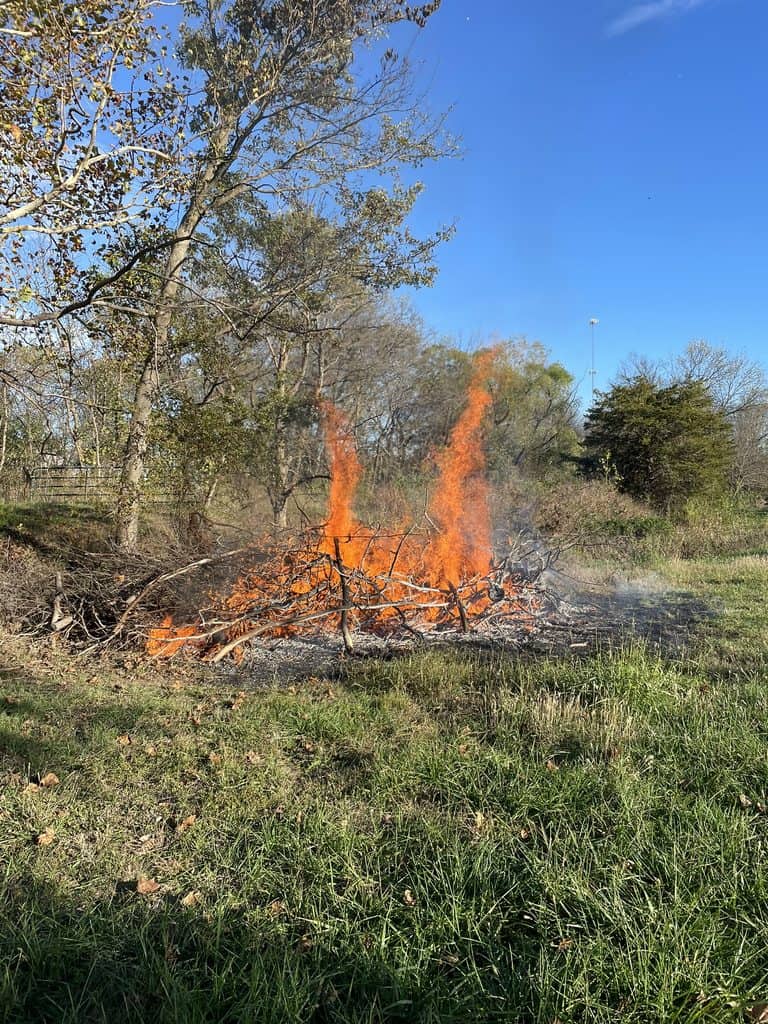
I didn’t get a picture earlier when it was really going, but here’s what it looked like after it died down.
You’ve probably had fires like this in your business. (Hopefully not lit by you!)
There’s what seems like a major problem, and everyone can see it.
It’s spectacular, in a frightening sort of way.
And, as a result, it gets all the attention.
Everyone gathers around and talks about the crisis.
The conversations focus on the potential problems it might cause and the mitigation plans that have been put in place.
The energy invested in worrying and speculating generates almost as much heat as the fire itself.
But then, before you know it, the fire is gone.
That’s what happened with the dry cedar tree brush pile.
It burned hot and fast, scared the crap out of me for a while, and then died down.
The steps I had taken to make sure it wasn’t going to spread and cause more damage had worked.
I lit it and checked it regularly to make sure it was going to burn safely like I anticipated.
And it did.
While my emotions were causing me to feel like I had a massive crisis of my own doing to deal with, things were actually fully under control.
The attention-grabbing crisis wasn’t actually that big of a deal.
Just like some of the problems in your business.
When you’ve prepared properly, the situations that cause others to panic and tempt you to do the same are short-lived.
They flare up. You fix them. They’re gone.
And you go about your business.
But based on my experience in the real world, not all the fires in your company are like that.
Some of the problems you deal with don’t show themselves so clearly.
They’re less spectacular and don’t immediately draw a crowd.
But they’re there and their negative effects can last a long time, impacting not just you and your immediate team but the people around you.
That’s what happened with the second brush pile we burned.
This brush pile didn’t have a crispy, dry cedar tree in it.
And that was a very good thing because it was near the sheep pens and the barn full of highly combustible hay.
I knew I didn’t want this fire to get anywhere close to that source of fuel.
That was a danger I recognized.
But I missed a more subtle risk.
I’d used our backhoe to push a big tree trunk and other brush into a pile, with a bunch of dirt at its base. A pile right next to our newly created compost area.
Our compost area isn’t your standard backyard variety.
It’s massive.
We created it a few weeks ago when we cleaned out the big stall in the barn.
As you can see, Mount Manure is a mini-mountain of sheep poop and straw.
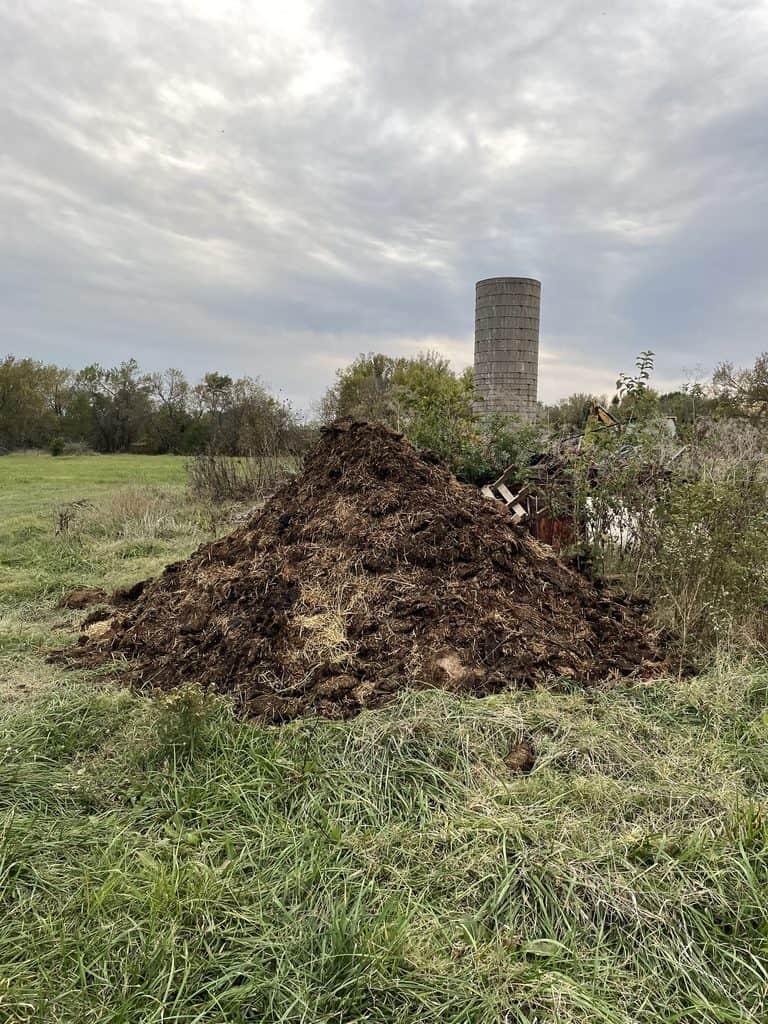
And I started fire number two right next to it.
I realize now that wasn’t my best decision. I’ve still got a lot to learn about this farming thing.
It burned well, but the column of flame wasn’t anything like the first one nor was my anxiety level.
This fire was fully under control.
Just like some of the fires you’re fighting in your business.
You’re dealing with them and they seem to be managed.
These problems don’t draw the same level of attention as the crisis that shows itself with a massive column of flame everyone can see.
But an issue like this is annoyingly persistent. It just won’t go away.
It takes your time and attention day after day and it’s constantly in the back of your mind bothering you.
That’s what happened with fire number two.
Because it was so close to the livestock and the barn, we decided to put it out before we left the farm for the night.
We watered it down and got rid of the flames and the red-hot coals.
But when we went back to the barn the next day, the smell of smoke was strong.
The wind hadn’t picked up, so the haze was hanging in the air.
I was hoping the neighbors down the road had their windows closed because their house would have smelled terrible.
I knew our problem had become their problem even though they weren’t complaining.
It didn’t take a visible fire at our place for them to identify the source of the stink.
So, I set about trying to fix the problem with more shoveling and more water.
I hoped I had finally put the fire out, but I wasn’t sure.
This non-spectacular problem was still on my mind even when I left the farm.
Part of the reason I couldn’t forget it was because my clothes smelled like smoke. The stench of the barn issue came home with me.
I’m sure you can relate because you know how hard it is to leave work at work.
You do your best to be fully present at home with your family, but it’s not easy.
Especially when you know one of your work fires is still smoldering.
The root cause of the problem hasn’t yet been resolved.
That’s what was happening with our brush fire.
It had become a compost pile fire.
The straw and the manure was still smoldering and spreading under the surface.
It took me several days of shoveling and watering to get it all put out.
I had to check it several times before I was convinced I was done.
That fire I was fighting stayed on my mind for days.
I could smell it and I knew others could too.
The problem under the surface was creating a working environment at the farm that wasn’t enjoyable or healthy.
The source of the symptoms was buried and it had to be found and dealt with for the situation to improve.
I’m convinced that Mount Manure would have burned internally for weeks. Maybe months if I’d let it.
You may have similar problems in your business. Often these involve the people on your team.
Like the smoke from our smoldering fire at the farm, the negative effect of the fire you’re fighting is real.
You’re carrying it with you when you go home.
Your coworkers are experiencing it, even though they don’t say anything.
You know this fire is creating more damage than the one everyone else sees and is talking about.
Because you can’t get rid of it and fighting this fire day after day is exhausting.
I encourage you to stick with it and keep working to find the root cause of the issue.
If you’re like many of the business leaders I work with, fires like these are often related to the common, natural challenges of working together as a team.
Even when you’re leading good people, you’re going to have problems. And many times these problems are related to working together as a team.
Small issues can be smoldering below the surface and creating a working environment that isn’t as healthy as you want it to be. Your team’s performance may be suffering as a result too.
If you’re fighting big, highly visible fires and need some encouragement to help you keep your blood pressure down or just smelling smoke and wondering what’s causing it, I’d love the opportunity to support you.
Together we can talk through your situation and help you identify your next best step.
You don’t have to keep fighting your fires alone.
Helping you lead with kindness and confidence,
Greg
P.S. Getting a different perspective on a fire you’re fighting makes a big difference. That’s one of the biggest benefits of the Leadership Clarity Accelerator small-group coaching program based on the feedback from leaders who’ve gone through it.
This is how one LCA alum described it:
“Learned a ton from other leaders in the cohort too. We came from different backgrounds, roles, industries, all wrestling with the same stuff and all working to become the best versions of ourselves for our teams.
Now leading at home, at church, at work… things just feel like they’re clicking. I ask better questions instead of assuming I already know the answer.”
The next LCA cohort starts in January, and I intentionally keep the group small.
If you’re interested in joining us or have someone on your team in mind, let me know before this cohort fills up.
If you’d like to see any of my previous newsletter issues, you can find them here along with other articles. And, if you’re not getting my weekly newsletter and would like to, just enter your info here.

Greg Harrod
Greg Harrod is a Business Coach and Strategic Communications Partner. Follow GregHarrod.com to learn how you can build clear communication, aligned teams, and simple rhythms so your business runs smoothly. Greg will help you learn how to go from daily firefighting to calm, confident leadership by sharing his 30+ years of experience leading teams and businesses.
A quick note about affiliates
Some of the pages on my website contain affiliate links to products, apps, and services. If you click through and purchase, I may receive a commission on the sale and you pay no more. My policy is to only affiliate with products and services that I believe will provide value to you.