“What are you doing?”
I was in the university welding shop when my boss asked me that.
He had more years of experience than I’d been alive and I still had a lot to learn. But the answer to that question seemed pretty obvious to me.
I had a push broom in my hands, and I was using it to transfer dirt from one location of the concrete floor to another. Perhaps he wasn’t aware that I had also masterminded a plan to later move that collected dirt into a dustpan and then into the trash can.
Was I missing something? Or was this a trick question for the new kid?
This was one of the two jobs I had while going to summer school before I started my first fall co-op term with Caterpillar. The other was doing MATLAB programming for one of my professors in his air-conditioned office.
Neither of these were anything like what I had done to make money during all my summers up to that point.
I started mowing yards with my mom when I was 10 and then switched to working for my dad in his welding shop when I was 14. (Thanks, Mom, for teaching me how to work hard and run a business at an early age.)
Air conditioning had never been a part of either of those jobs.
But I thought this welding shop would be very similar to working at my folks’.
Turns out I was wrong.
My first clue should have been the route my coworker drove to get from one side of the campus to the other.
We needed to do some repair work in a tunnel below the campus, and it couldn’t have been more than a 3-minute walk from the shop.
It made sense to take a truck since it had all the equipment we needed.
But here’s the part that was completely new to me.
My coworker took the scenic route. So it took us FOREVER to get to where we were supposed to be working.
At the time, Manhattan wasn’t as big as it is now. And, to clarify, I mean the Little Apple not the Big Apple. Kansas, not New York. It’s an easy mistake to make. Just as the Boeing recruiter who sent me airline tickets departing from La Guardia… but that’s a story for another time.
But as long as it took us, you would have thought we were fighting New York City traffic.
If you knew how my dad worked and what he expected of his employees, you would know why this shocked me.
I can still remember him taking me aside one day after I had been standing by him to listen in on a conversation he was having with a customer. He very clearly explained to me that I was being paid to work not to stand there.
Obviously, my new teammates at the welding shop, including my boss, had never worked for my dad.
Because here’s what happened between my boss and me just before I started sweeping.
I arrived for my shift and asked him what he wanted me to do that day.
He said, “Nothing.”
That’s where the miscommunication occurred.
I suppose it was the echo of these words I’d heard from Mom and Dad more times than I can count that caused me to misinterpret his directive and drove me to cleaning.
“You can always find something to do.”
It was a natural reaction for me to start picking up welding rod ends, stacking scrap metal, and sweeping the floor.
So that’s what I did.
Until my boss explained to me that what he wanted me to do was to sit down beside him at his desk while he read the newspaper.
He wanted me to do what he was doing: NOTHING!
Not clean.
Not study for my Matrix Theory exam.
Not optimize the driving route for the next job.
He didn’t want me to do anything productive.
Even though MY tuition payments were funding both of our wages.
I can’t remember one thing I learned in Matrix Theory that summer, but I can remember this experience like it was yesterday.
So why am I sharing this story with you?
I’m convinced that you want the people on your team to do meaningful work. And the people you’ve hired want to add value by applying the talents they were born with and the skills they’ve developed.
It would be easy to read about my experience in the welding shop during college and miss an important leadership lesson.
We might assume the guys I worked with were lazy. Or that state government jobs are filled with wasteful practices. Or that organizations in the ‘80s hadn’t yet been forced to get lean and efficient.
I’ll admit it’s also quite possible that I have a completely inaccurate memory and interpretation of the incident now that I know that the frontal lobe of my brain wasn’t fully developed at that age.
That little tidbit of human anatomy knowledge explains a lot, doesn’t it?
So all of those speculations may or may not be true. But they’re not the point.
The point is that I’ve seen versions of this happen throughout my career.
They just weren’t as blatant about it.
These high-level leaders didn’t tell their people to “do nothing.” But their actions caused the same response in their people as it did in me.
I can recall dozens of conversations when excellent employees said, “I’m just not very busy.” Those were their words, not mine.
They wanted to do more and talked to their supervisor about it, but they still weren’t being challenged.
So they dreaded coming to work because they knew they would be underutilized.
Not only were they bored, but they also felt nagging guilt.
Because just like me and my welding shop boss that summer, they were still being paid a full paycheck whether they were fully utilized or not.
And that didn’t match up with who they were and how they’d been raised.
One situation still pains me to think about.
A talented, highly-motivated young man was performing well and meeting expectations, but he wasn’t given enough meaningful work to do.
This was obvious to the people around him because he was openly looking for ways to contribute more. He was constantly asking for opportunities to do work beyond what his official job description required.
And it wasn’t that he was in a department that had too many people or supporting a product that was reaching the end of its life.
The project he was on was one of the biggest in the company’s history and behind schedule. There was more than enough work to do.
Eventually, his boss acknowledged that there was a problem. But it was too late.
He left the company.
And the cost in time and money to replace him added even more pressure to this high-visibility project.
Unfortunately, this is just one of too many similar stories I could share with you.
But I won’t.
Instead, I’ll share this bit of advice that was shared with me and a few of my recommendations based on having the privilege of leading some incredible people.
This is the leadership advice that was shared with me:
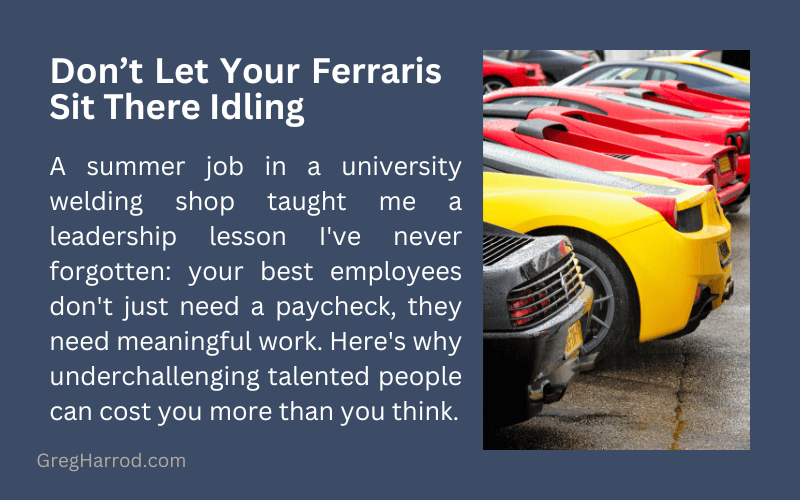
“Don’t hire Ferraris and just let them sit there idling.”
The application of that simple tip is obvious.
Leaders often assume people leave because they’re overworked. Sometimes they leave because they’re underchallenged.
When you’ve got high-performing, highly motivated people on your team, do all you can to let them do what they’re made to do.
Give them work that challenges them.
Learn what energizes them, what they’re naturally good at, and then give them opportunities to use those strengths.
Create a culture that makes it easy for them to tell you when they don’t have enough work.
Look for projects that are missing skills your people have. Then position them to fill those gaps.
Years from now, the people who report to you may still remember the assignments you gave them. What story do you want them to tell?
I’m confident they’re going to talk about how you were the leader that gave them tasks that challenged them, energized them, and allowed them to make a significant impact on your business by doing what they were built to do.
And that’s a legacy you can be proud of.
Helping you lead with clarity and confidence,
Greg
P.S. If this newsletter resonated with you, let’s talk. If you feel like everything still depends on you, I’d love to help you develop your people so your business can grow. I’ve opened a few complimentary 45-minute coaching sessions over the next couple of weeks. You can reserve one here using my scheduling link.
P.P.S. I recently had the privilege of joining Dave Crysler on the Crysler Club podcast. We had a great discussion about why your most reliable employees are often the closest to burnout and what leaders can do to prevent it. You can listen to our conversation here.
If you’d like to see any of my previous newsletter issues, you can find them here along with other articles. And, if you’re not getting my weekly newsletter and would like to, just enter your info here.

Greg Harrod
Greg Harrod is a Business Coach and Strategic Communications Partner. Follow GregHarrod.com to learn how you can build clear communication, aligned teams, and simple rhythms so your business runs smoothly. Greg will help you learn how to go from daily firefighting to calm, confident leadership by sharing his 30+ years of experience leading teams and businesses.
A quick note about affiliates
Some of the pages on my website contain affiliate links to products, apps, and services. If you click through and purchase, I may receive a commission on the sale and you pay no more. My policy is to only affiliate with products and services that I believe will provide value to you.