
This article is part of an email series covering the results of the 2025 Wichita Industrial Trade Show (WITS) Leadership Pulse Survey. If you missed any of the emails in the series, you can see them all here. And, if you’re not getting my weekly newsletter and would like to, just enter your info below.
Hello!
As I said in my last email, I don’t think this part of the 2025 Wichita Industrial Trade Show Leadership Pulse Survey is going to surprise you.
Sixty-eight of the 120 survey participants answered the last question:
If you could fix one problem with your team dynamics, what would it be?
And 34% of the answers had something to do with an age-old business (and human) problem, Communication.
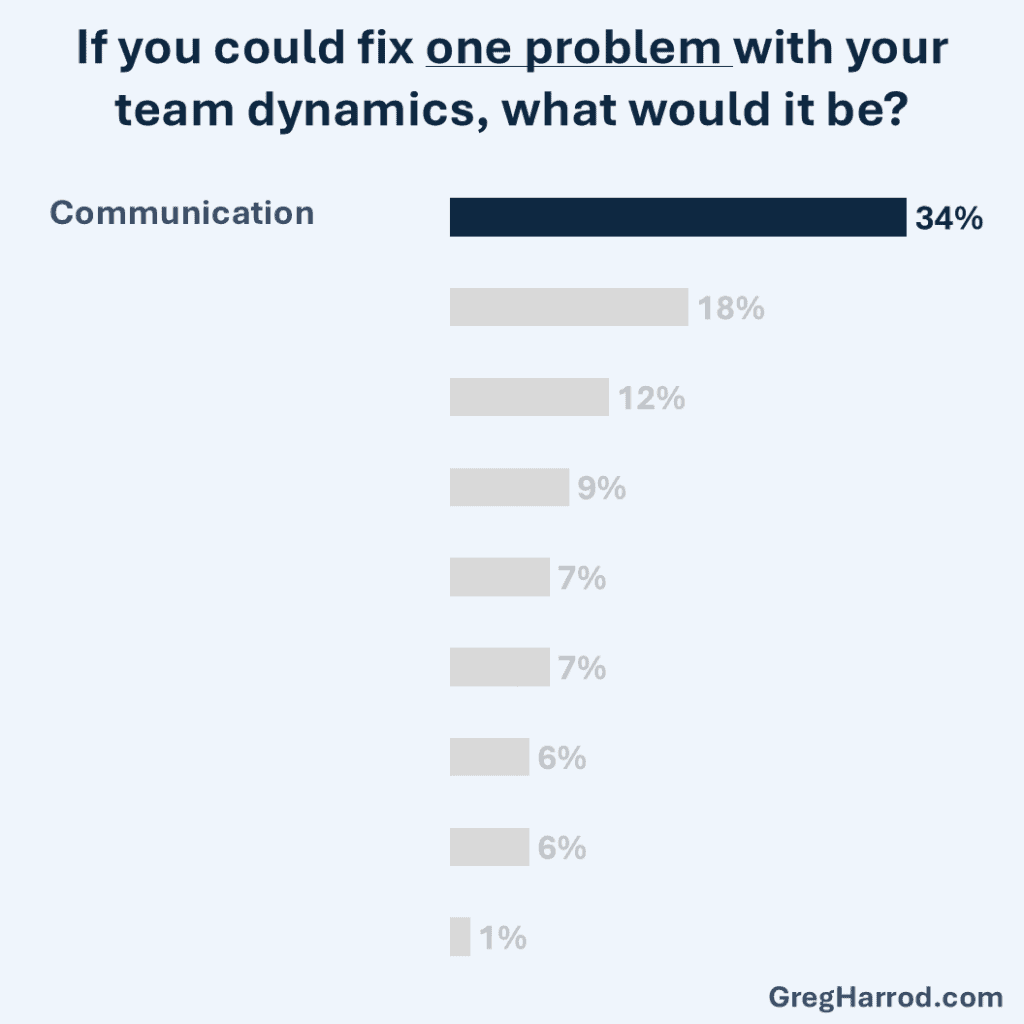
Here are some examples of what other business leaders (or maybe you) said was the one problem they would fix if they could.
If you could fix one problem with your team dynamics, what would it be?
“Open communication”
“Better communication”
“Volume of communication”
“Communication between teams”
“More internal communication on what projects are developing”
“Complete buy-in to the company’s direction, … need to work on delivering that message”
If you answered with a comment like this, you’re not alone.
That’s comforting, sort of…
But, what can you do right now to make progress in this area?
How to Make Progress Toward Improving Communication in Your Business
Here’s how we’re going to approach this problem (and the others in future emails).
We’re going to focus on what YOU can control and how you can take action.
But we’re also going to avoid a common mistake too many business leaders make. We’re not going to start with immediately taking action.
We’re going to follow the 3 phases of work outlined in the Working Genius productivity model: Ideation, Activation, and Implementation.
- Ideation (Identifying the need for change. Generating ideas and solutions.)
- Activation (Assessing ideas and solutions. Pushing forward with action.)
- Implementation (Build momentum with others. Deliver results.)
In other words, we’re going to pause briefly to think and plan then act intentionally to maximize your productivity.
Let’s apply this Ideation, Activation, Implementation model to the problem of Communication within your business.
Ideation (Identifying the need for change. Generating ideas and solutions.)
Ask yourself these questions:
Which of our business challenges in the past few weeks might have been avoided if we had communicated more effectively?
How might I learn from my team what they consider to be our biggest communication gaps?
What opportunities do I already have in my weekly rhythm of work that will allow me to learn from my team members?
Spend a few minutes asking yourself questions like these and brainstorming some ideas of actions you can take this week. Then write down your favorites.
If you feel overwhelmed or stuck when you try to come up with ideas like this, ask the person on your team who seems to have a never-ending list of ideas flowing out of their brain. They would probably love to help you!
Here are a few ideas to get you started.
Use Your 1×1 Meetings To Improve Communication
Adjust the agenda of your one-on-one meetings with your direct reports to include time to intentionally listen to them describe the communication problems they are experiencing.
Invite them to be open and honest and explain that you are truly seeking to learn and understand.
Try to avoid any natural instinct you may have to talk more than listen or to solve the problems immediately.
It’s hard but it’s worth it.
Create a Survey To Improve Communication
Create a simple survey to gather input from your team on what they like most and least about the communication methods leaders (including you) use in your business.
Ask them for suggestions on how to improve communication barriers they are dealing with.
Ask Thoughtful Questions to Improve Communication
Prepare a series of thoughtful questions to help you dig below the surface when you get pat answers like, “Engineering never talks to the shop.”
Questions like, “What sort of information would be most useful for the manufacturing team to get from the design group?” and “What steps do you think we could take to connect those teams so they can share their knowledge with each other?” can help you lead your teams to communicate more effectively.
Activation (Assessing ideas and solutions. Pushing forward with action.)
Take your favorite idea from the Ideation exercise and spend a few minutes considering if it will really work. You may want to invite a trusted colleague who enjoys thinking through risks and potential pitfalls to talk through it with you.
Don’t overthink it. Just pause long enough to do a gut check or get wise counsel.
If your first selection doesn’t seem like a good one to pursue, try another one.
Then commit to taking action on one of your ideas you can implement today or tomorrow. Make a decision and give yourself deadlines. Then make it happen!
If your idea to improve communication in your business involves other people and you don’t feel comfortable being the cheerleader for your idea, find a partner who loves to inspire and challenge others to take action and ask them for help.
Implementation (Build momentum with others. Deliver results.)
Remember that you don’t have to be (and probably shouldn’t be) the only one involved with implementing your communication improvement idea.
Think of people in your business who get energy from helping other team members get involved or those who are passionate about finishing every little detail of a job – and on schedule.
For instance, if you decide to do a survey with your team to see what communications methods they like or dislike, you don’t have to do all the work yourself. You may have people in your business who would be thrilled to help you write a survey or compile the results or distribute them throughout the organization.
I encourage you to think beyond job titles and consider who you might involve based on their natural talents and abilities not just their current job description.
Those are a few of my recommendations on how you can get started addressing Communication, the biggest problem business leaders identified in the WITS Leadership Pulse Survey.
Now it’s your turn.
How Do You Want to Start Making Progress in Your Business?
What do you want to do in your business to improve Communications?
I’d love to hear what you think will work for you and your teams and what actions you’re planning to take this week.
Shoot me a quick reply if you would please so I can learn from you and continue to improve as a Business Coach.
Be watching your inbox for our next email when we take on the topic, “Teamwork and Relationship Dynamics.”
While the number of survey responses related to this area was lower than “Communication”, the verbatim comments were much deeper and more provocative.
Terms like “ego,” “drama,” and “Kansas nice” came out so leaders were willing to share what they believe is really going on behind the scenes!
Helping you lead with clarity and confidence,
Greg
This article is part of an email series covering the results of the 2025 Wichita Industrial Trade Show (WITS) Leadership Pulse Survey. If you missed any of the emails in the series, you can see them all here. And, if you’re not getting my weekly newsletter and would like to, just enter your info here.

Greg Harrod
Greg Harrod is a Business Coach and Strategic Communications Partner. Follow GregHarrod.com to learn how you can build clear communication, aligned teams, and simple rhythms so your business runs smoothly. Greg will help you learn how to go from daily firefighting to calm, confident leadership by sharing his 30+ years of experience leading teams and businesses.
A quick note about affiliates
Some of the pages on my website contain affiliate links to products, apps, and services. If you click through and purchase, I may receive a commission on the sale and you pay no more. My policy is to only affiliate with products and services that I believe will provide value to you.