This article is part of an email series covering the results of the 2025 Wichita Industrial Trade Show (WITS) Leadership Pulse Survey. If you missed any of the emails in the series, you can see them all here. And, if you’re not getting my weekly newsletter and would like to, just enter your info below.
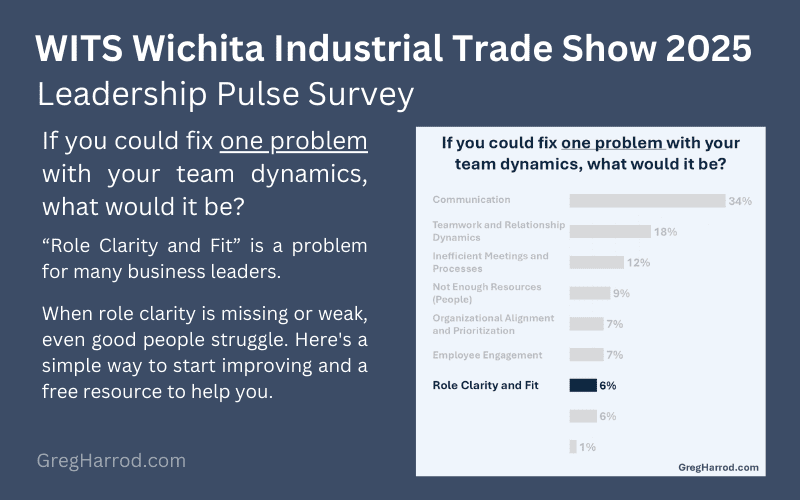
The idea of “Role Clarity and Fit” was another common response to the question, “If you could fix one problem with your team dynamics, what would it be?” on the 2025 Wichita Industrial Trade Show Leadership Pulse Survey.
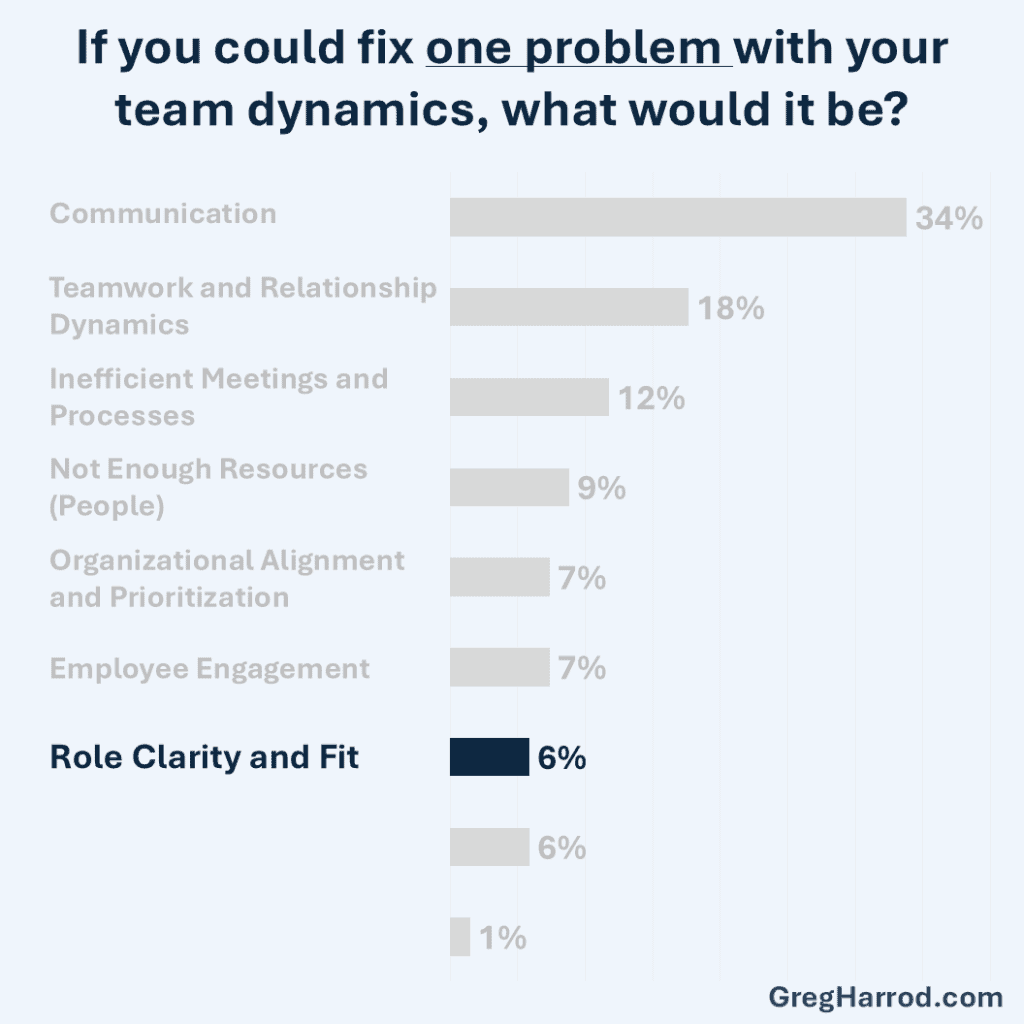
If you could fix one problem with your team dynamics, what would it be?
You and other business leaders like you answered like this:
- “Clarity of roles”
- “More defined roles”
- “Right people in right positions”
These different phrases all reveal the same underlying issue.
Role clarity.
When Role Clarity Is Missing, Even Good People Struggle
Most leaders I talk with don’t believe they have a people problem.
They believe they have a clarity problem.
They have capable, hardworking people who want to do well, but who are unsure about:
- what they truly own
- how their role fits into the bigger picture
- where their responsibilities begin and end
- what “good” actually looks like in their position
When those things are unclear, people either hesitate or overstep.
They wait to act because they’re afraid of making a mistake and don’t want to get it wrong. Or they take on work that was never meant to be theirs.
Either way, their frustration builds. And so does yours.
And leaders often experience it as performance issues, engagement issues, or even hiring issues, when the real problem is much simpler.
The work is unclear.
Role Clarity Is Not a Job Description Problem
Many organizations assume role clarity is handled once a job description is written.
In reality, job descriptions rarely keep up with:
- changing business needs
- team growth or contraction
- shifts in strategy or priorities
- the natural evolution of people’s strengths
Role clarity is not a one-time document. It’s an ongoing conversation, a regular dialogue between employees and their supervisors.
And when that open, honest discussion doesn’t happen, confusion quietly creeps in.
A Simple Place to Start Improving Role Clarity
When leaders ask me where to begin with role clarity, I almost always recommend starting with one basic question:
“What are you actually doing right now?”
Not what the job description says. Not what you think the role should be.
What is the person actually spending time on day-to-day?
Without answering that honestly, it’s almost impossible to clarify roles, rebalance workloads, or put the right people in the right positions.
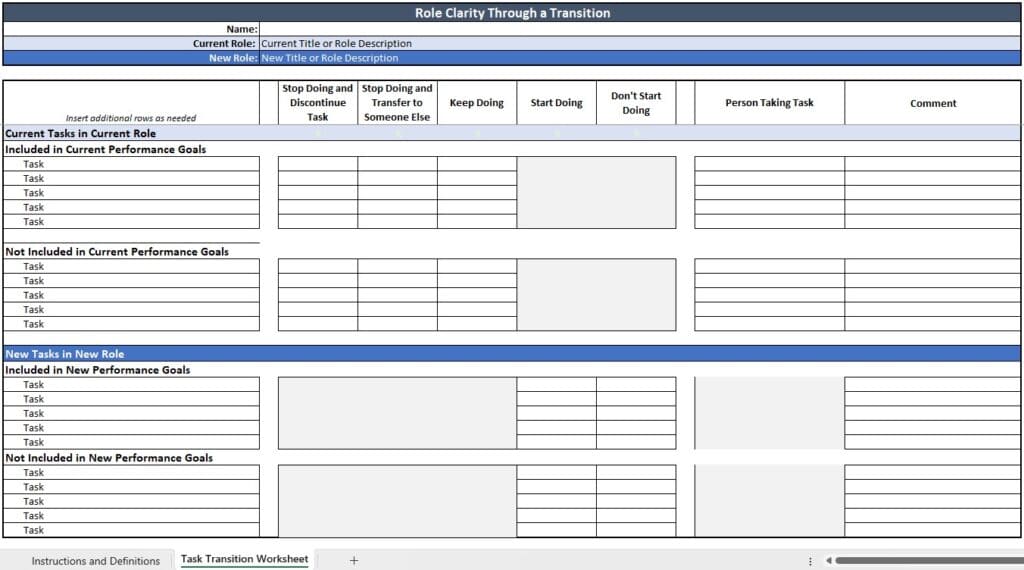
Over the years, I’ve used a simple Role Clarity through a Transition worksheet with individuals and teams going through growth, change, or frustration. It helps leaders and team members slow down just enough to better understand:
- current responsibilities
- gaps that need to be filled
- responsibilities that no longer fit
- misalignment that’s causing unnecessary stress
It’s especially useful during transitions like new hires, role changes, or when leaders feel like they’re carrying too much themselves.
I’m making this worksheet available as a free resource because it has helped so many teams move from frustration to clarity with surprisingly little effort.
You can download a copy of the Role Clarity through a Transition worksheet by clicking here or on the image below.
I encourage you to give it a try and see if it works for you. It’s a fully editable Excel spreadsheet so feel free to modify it to make it fit best with your team and what you’re seeking to do to improve role clarity in your business.
How’s the Role Clarity in Your Business?
If you were completely honest, where do you see role clarity breaking down in your business right now?
Is it unclear ownership?
Misaligned expectations?
People doing work they were never meant to do?
Or are you in pretty good shape in this area of your business?
If you’d like, hit reply and tell me what you’re seeing. I read every response myself, and your insight helps shape what I share next.
Helping you lead with clarity and confidence,
Greg
P.S. The Six Types of Working Genius framework is another great tool for clarifying roles and making sure people are doing the work they’ve been created to do. You can learn more about how I can support you and your teams when you’re ready to apply this model on this page of my website, Working Genius Coaching.
This article is part of an email series covering the results of the 2025 Wichita Industrial Trade Show (WITS) Leadership Pulse Survey. If you missed any of the emails in the series, you can see them all here. And, if you’re not getting my weekly newsletter and would like to, just enter your info here.

Greg Harrod
Greg Harrod is a Business Coach and Strategic Communications Partner. Follow GregHarrod.com to learn how you can build clear communication, aligned teams, and simple rhythms so your business runs smoothly. Greg will help you learn how to go from daily firefighting to calm, confident leadership by sharing his 30+ years of experience leading teams and businesses.
A quick note about affiliates
Some of the pages on my website contain affiliate links to products, apps, and services. If you click through and purchase, I may receive a commission on the sale and you pay no more. My policy is to only affiliate with products and services that I believe will provide value to you.