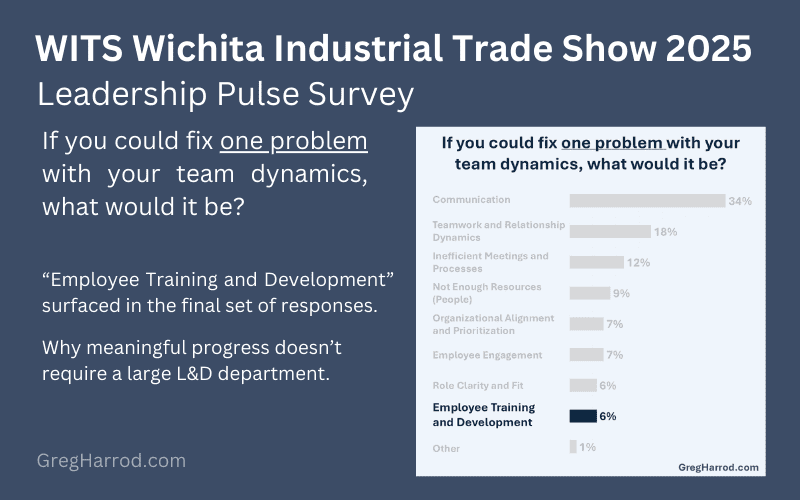
This article is part of an email series covering the results of the 2025 Wichita Industrial Trade Show (WITS) Leadership Pulse Survey. If you missed any of the emails in the series, you can see them all here. And, if you’re not getting my weekly newsletter and would like to, just enter your info below.
“Employee Training and Development” surfaced in the final set of answers to the question, “If you could fix one problem with your team dynamics, what would it be?” on the 2025 Wichita Industrial Trade Show Leadership Pulse Survey.
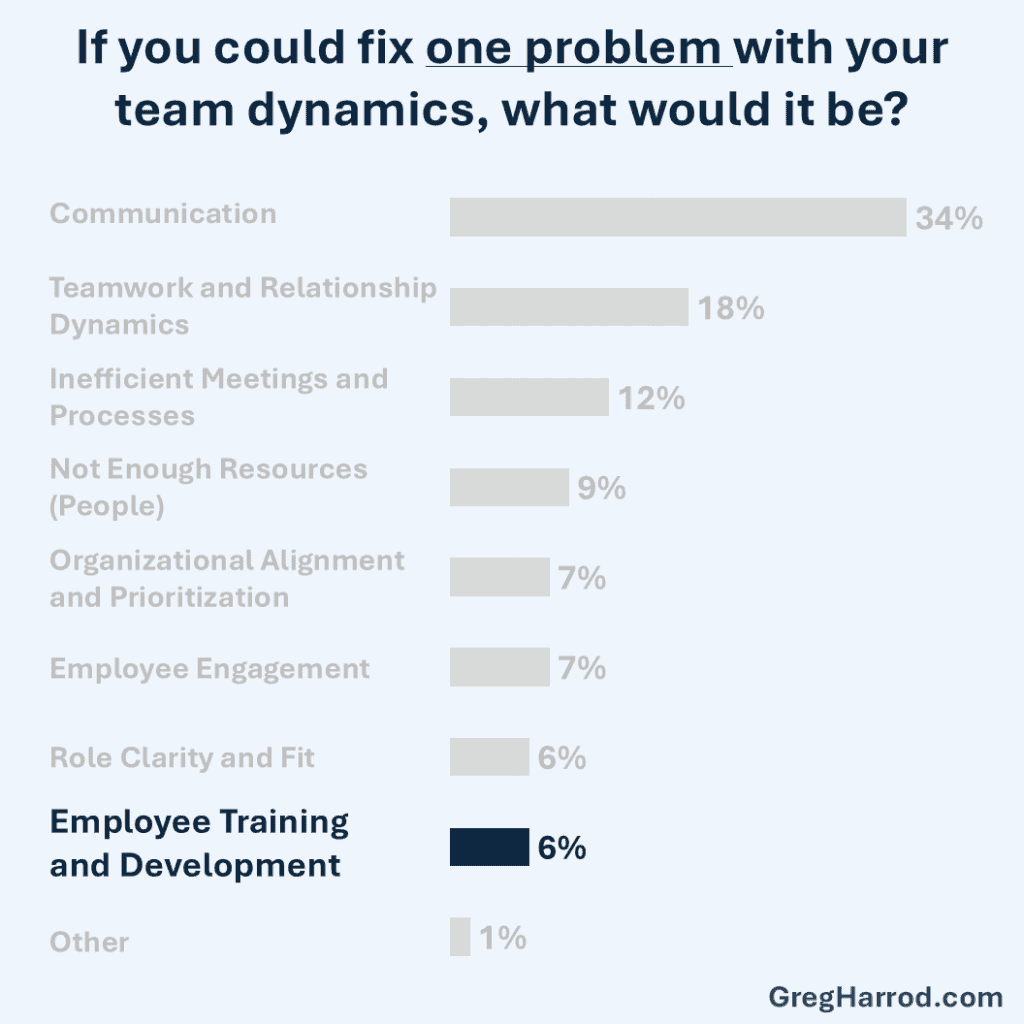
You probably aren’t surprised by answers like these:
- “Education”
- “More training”
- “Educational opportunities”
You may have heard similar comments from people on your team. Or you may have been thinking the same thing yourself.
If you’re concerned about the learning opportunities your people are getting, or not getting, you are not alone.
And your concern is justified.
Learning is directly connected to employee retention, which we talked about earlier in this series.
Why Your Concern Is Real
Here’s the reality many leaders are facing right now and research confirms.
Employees are increasingly saying, “I expect my employer to help me keep up. If not, I will go somewhere else.”
That pressure is real.
But here is the good news.
You don’t need a large learning and development department to make meaningful progress.
And in many cases, the issue leaders are really worried about is not training at all.
It’s development.
Training Is Not the Same as Development
Most people will always need training on the specific tasks of their job. That matters.
But over time, what keeps good people engaged and growing is something deeper.
They want to improve how they think, decide, and contribute.
They want to grow in:
- clarity
- judgment
- confidence
- self-awareness
- their ability to help others succeed
That kind of development doesn’t require a formal program.
It requires leadership attention.
A Practical Place to Start Developing Your People
One practical place to start is decision-making.
If you’re running a manufacturing, trades, or service-based business, you and your team are making decisions constantly.
The quality of those decisions directly affects your results.
Yet most leaders have never actually been taught how to think clearly about decisions.
By “how,” I don’t mean a checklist that magically produces perfect outcomes. That’s not how real decisions work.
I mean learning how to slow down long enough to get clear before rushing to solutions.
One simple practice I’ve found helpful is pausing early and wrestling with two questions as a team:
- What problem are we actually trying to solve, or what opportunity is in front of us?
- What does success look like if we get this right?
If most teams stopped there, they’d already be miles ahead of where they are today.
The clarity that comes from sitting with these questions is powerful.
Leaders are often tempted to move too quickly past this step.
But when you give people the time and space to think deeply here, something important happens later.
Second-guessing decreases.
Confidence increases.
And people feel trusted instead of micromanaged.
That’s development in action.
You’re not just teaching people what to do.
You’re helping them learn how to think.
My Recommendation
Start With a Real Decision
If you want to support your people’s development in a practical, sustainable way, start right at the decision point.
Choose one real decision your team is currently facing.
Not a hypothetical.
Not a small one that doesn’t matter.
Something that has real consequences.
This keeps the work grounded in reality and immediately relevant.
Slow Down Before You Speed Up
Before you move into action, slow the process down just enough to get clear.
Spend intentional time in the space between evaluating options and mobilizing the team.
This is where many teams struggle, not because they don’t care, but because the pressure to act is strong.
Some people are wired to sit with ambiguity, weigh tradeoffs, and sense whether an idea is ready.
Others are wired to move, help, and get something done.
That tension is normal.
But this is also the moment where development happens.
Practice Clarity Together
Invite the people involved to clearly articulate the problem or opportunity as they see it.
Then align on what a good outcome actually looks like before discussing solutions.
Resist the urge to rush past this step, especially if you gain energy from action and execution.
Your role here isn’t to be the smartest person in the room.
It’s to model what it looks like to think clearly before moving decisively.
Notice What Changes Over Time
When teams learn to honor this pause:
- decisions improve
- confidence increases
- rework decreases
People begin to trust not just what they’re doing, but why they’re doing it.
Over time, they don’t just execute better.
They think better.
That’s what development looks like in practice.
Why This Approach Works
This approach works because it meets people where they actually struggle.
Most teams don’t fail because they lack effort or commitment.
They struggle because they move too quickly from ideas to action without shared clarity.
When leaders slow the team down at the decision point, a few important things happen.
First, people stop guessing.
They understand what problem they’re solving and what success looks like.
Next, confidence replaces urgency.
Action becomes purposeful instead of reactive.
Over time, this builds something deeper than better execution.
It builds trust.
People trust the decisions they’re making.
They trust the direction they’re heading.
And they trust the leaders who are willing to pause long enough to think clearly.
That’s why this kind of development doesn’t require a program or a department.
It grows out of everyday decisions handled well.
And it compounds quietly, decision by decision, conversation by conversation.
That’s how real development takes root and grows in a team.
Helping you lead with clarity and confidence,
Greg
P.S. If you try slowing down at the decision point this week, I’d love to hear what you notice. What changed in the conversation, the confidence, or the outcome? Just reply and let me know. I read every response myself.
This article is part of an email series covering the results of the 2025 Wichita Industrial Trade Show (WITS) Leadership Pulse Survey. If you missed any of the emails in the series, you can see them all here. And, if you’re not getting my weekly newsletter and would like to, just enter your info here.

Greg Harrod
Greg Harrod is a Business Coach and Strategic Communications Partner. Follow GregHarrod.com to learn how you can build clear communication, aligned teams, and simple rhythms so your business runs smoothly. Greg will help you learn how to go from daily firefighting to calm, confident leadership by sharing his 30+ years of experience leading teams and businesses.
A quick note about affiliates
Some of the pages on my website contain affiliate links to products, apps, and services. If you click through and purchase, I may receive a commission on the sale and you pay no more. My policy is to only affiliate with products and services that I believe will provide value to you.